
Roads to Memphis: Chapter 1
Clip: Season 30 | 9m 7sVideo has Closed Captions
Watch Chapter 1 of Roads to Memphis.
Watch Chapter 1 of Roads to Memphis.
Problems playing video? | Closed Captioning Feedback
Problems playing video? | Closed Captioning Feedback
Corporate sponsorship for American Experience is provided by Liberty Mutual Insurance and Carlisle Companies. Major funding by the Alfred P. Sloan Foundation.
Support provided by:


Roads to Memphis: Chapter 1
Clip: Season 30 | 9m 7sVideo has Closed Captions
Watch Chapter 1 of Roads to Memphis.
Problems playing video? | Closed Captioning Feedback
How to Watch American Experience
American Experience is available to stream on pbs.org and the free PBS App, available on iPhone, Apple TV, Android TV, Android smartphones, Amazon Fire TV, Amazon Fire Tablet, Roku, Samsung Smart TV, LG TV, and Vizio.
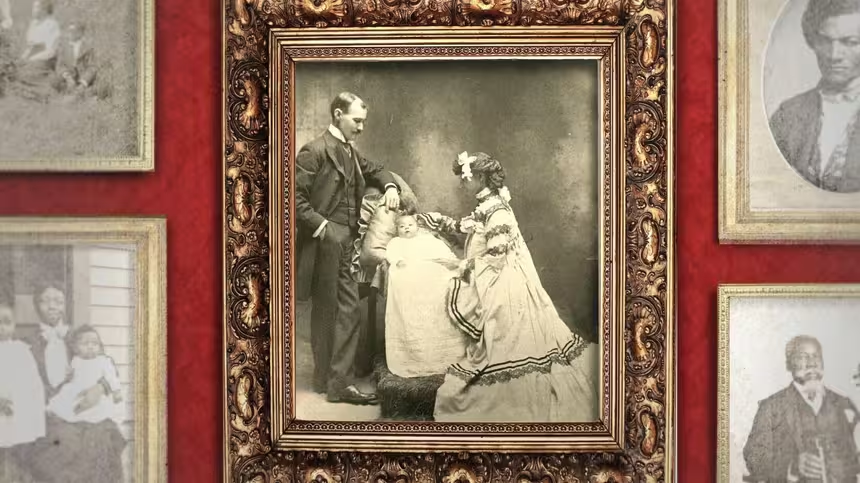
When is a photo an act of resistance?
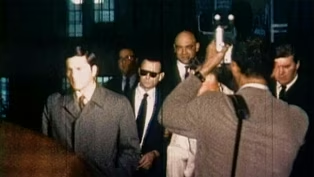
For families that just decades earlier were torn apart by chattel slavery, being photographed together was proof of their resilience.♪ ♪ (siren wailing) ♪ ♪ (crowd clamoring) ♪ ♪ MAN: At 3:48, Shelby County Sheriff's Department received into its custody James Earl Ray, the accused slayer of Dr.
Martin Luther King, Jr.
DAN RATHER: The second before his arrest, James Earl Ray was the most wanted man in the United States, one of if not the most wanted suspects in the world.
JOHN CAMPBELL: This was like assassinating a president in some ways.
King, by '68, was the face of the civil rights movement.
He was an international figure.
GERALD POSNER: When a public official the magnitude of King gets killed in the prime of their life, we can't quite imagine that.
You've got this young, charismatic preacher pulling together a movement with so much potential for the future.
On the other hand, you have a four-time loser, James Earl Ray, pulling off the assassination; it doesn't make sense.
Do you have anything you'd like to say right now at this time?
HARRIS WOFFORD: The greatest single blow to my spirit was the assassination of Martin Luther King.
A shudder went through the American people.
JOE SWEAT: I think it made America wake up.
You had people saying, "Golly, is this... "is this division we have with the blacks, has it come to this, do we actually shoot people down?"
SAMUEL KYLES: Martin Luther King was so convinced that the only way we could win the battle was nonviolently.
And he had made up his mind with all of the risk involved.
He wouldn't turn around.
He wouldn't give up.
ROGER WILKINS: There were black people who were saying that the magic was gone.
They were saying, "Well, he's always talking "about this peace stuff.
"That's not... that's not how the cracker is.
"The cracker's got guns and he's going to kill us and we got to have guns."
RATHER: The assassination speaks to what a dangerous time it was for the country, particularly for those who tried to give voice to our difficulties and the hope for a better day.
When James Earl Ray was arrested, the questions just flowed.
Is he really the slayer?
If he is the killer, what motivated him?
Why did he do it?
♪ ♪ POSNER: In 1967 James Earl Ray is sitting inside Missouri State Penitentiary, what's called Jeff City.
He's a career criminal.
He has committed dozens of crimes-- robberies of grocery stores, robberies of paycheck stores, taxicabs, office buildings, whatever else that he gets away with.
Finally he gets caught in robbing a grocery store with a gun and he gets sent to Jeff City.
He's done time already at two other prisons that aren't easy.
But Jeff City is different for him.
He tried to plan to escape from his second year in there.
Ray wanted out.
RADIO REPORTER: Civil disobedience drive in Washington.
Dr.
King said Congress has dragged its heels in efforts to uplift the economic levels of the poor.
MARTIN LUTHER KING JR.
(radio): Now, this has brought about a great deal of bitterness, anger.
HAMPTON SIDES: There's rumors swirling around Jeff City about a bounty for the head of Martin Luther King.
Some said it was $50,000, some said it was $100,000.
POSNER: A lot of the white inmates of Jeff City had straight racist views.
There was in fact an operating equivalent of a Klan operation inside.
So, if you were a white inmate who hated blacks in Jeff City, you might sit around and say, "Too bad we're in here.
"There's over 50,000 for somebody who can put a bullet in that preacher out there."
SIDES: It was early in the morning, and Ray was working in the bakery.
This was the morning that he was going to escape.
He went down to a loading dock area where the bread from the bakery was being cooled and got into one of these boxes that the bread was going out on and had a false bottom placed on top of him.
The box is placed inside a truck and the truck is waved on and goes out of the prison.
When the truck comes to a stop, he just jumps off the truck and takes off down the railroad tracks.
It's important to understand this was a maximum-security prison.
This is not an easy place to spring from.
It shows something about Ray's personality that he's very patient, he plans months ahead.
RATHER: He had a lot of street smarts, a lot of jail and prison smarts.
A cunning mind.
No one would call him brilliant, but it would be a mistake to think that he was dumb.
SIDES: When he escapes, he doesn't have very much on his person, but one particular artifact that he will have with him for the next year is his prison radio, a transistor radio.
(indistinct radio chatter) Ray was a news junkie.
He was fascinated by the news.
RADIO ANNOUNCER: Partly cloudy, chance of showers late this afternoon... CAMPBELL: I think he thought that he was a much bigger fish than he was.
He thought when he escaped from prison that he was going to be all over the news, that J. Edgar Hoover would be on TV saying, you know, "James Earl Ray's escaped.
We need your help to find him," kind of thing.
SIDES: Ray hoped to be on the F.B.I.
's Most Wanted list, and lo and behold, he didn't make it.
WAYNE FLYNT: Instead of being elated at escaping, he's actually disappointed, because what he wanted more than the anonymity of escape was the notoriety of publicity, of recognition.
SIDES: After Ray escapes, he goes to Chicago and has a rendezvous with his brothers, Jerry and John.
The Rays were pretty tight.
They all were involved in petty crimes of one sort or another and they trusted each other.
They talk about what they're going to do.
They talk about the porn business.
Ray's kind of interested in-in porno.
He thinks there's money to be made there.
They also talk about kidnapping as a possible way to make some money and various other lowlife schemes.
But then, finally, the subject of Martin Luther King comes up.
For Ray, yeah, he doesn't like King, but the main thing is there's money to be made.
He feels confident that he can connect with the right individuals and that this is a way that he can, as a free man, finally make a living.
The brothers were a little bit taken aback by that.
Too big an operation, too ambitious, too dangerous, too risky, but it was in keeping with Ray's personality.
In the family lore, in the family mythology, James was the smart one, he was the ambitious one.
He was the one that was going to do big things.
Clip: S30 | 1m 19s | Besides inventing Corn Flakes, John Kellogg helped promote the American Eugenics movement. (1m 19s)
Clip: S30 | 2m 6s | In 2001, George H.W. Bush wrote a letter for history, addressed to his children. (2m 6s)
Clip: S30 | 2m 32s | On April 4, 1968, RFK delivered the news of Dr. King’s assassination in Indianapolis. (2m 32s)
Video has Closed Captions
Clip: S30 | 2m 39s | In 1898, the Supreme Court ruled that Wong Kim Ark had acquired U.S. citizenship at birth. (2m 39s)
Clip: S30 | 35s | In 1882, President Chester A. Arthur signed into law the Chinese Exclusion Act. (35s)
The Chinese Exclusion Act: Promo
Preview: S30 | 30s | On May 6, 1882, President Chester A. Arthur signed into law The Chinese Exclusion Act. (30s)
The Chinese Exclusion Act: Preview
Preview: S30 | 3m 18s | Watch a preview of The Chinese Exclusion Act. (3m 18s)
Clip: S30 | 2m 1s | In April 1933, the Barrow gang holed up in Joplin, Missouri for a break from the road. (2m 1s)
Clip: S30 | 2m 26s | In 1925, the “Scopes Monkey Trial” pit traditional Christian beliefs against evolution. (2m 26s)
Clip: S30 | 1m 13s | Max Schmeling convinced the U.S. Olympic Committee to attend the 1936 Olympic games. (1m 13s)

Preview: S30 | 30s | A young Navy wife made a drastic rape allegation against five nonwhite Hawaiians in 1931. (30s)
Clip: S30 | 1m 15s | The assassination of Dr. Martin Luther King forever bound the two men in history. (1m 15s)
Clip: S30 | 1m 39s | Many feared the 1919 raids went too far — violating the civil liberties of people. (1m 39s)
Clip: S30 | 1m 25s | The law school grad was asked to run the “Radical Division” at the Justice Department. (1m 25s)
Mary Elizabeth Lease: The Advocate
Clip: S30 | 1m 32s | Women couldn’t run for elected office in Kansas, but Mary Elizabeth Lease was a force. (1m 32s)
Clip: S30 | 1m 9s | When one of the richest men in America feared a collapse of the U.S. dollar, he had a plan (1m 9s)
Henry George: From Poverty to Politics
Clip: S30 | 1m 35s | Henry George’s message about the haves and the have nots helped ignite a movement. (1m 35s)

Video has Closed Captions
Clip: S30 | 10m 6s | Watch Chapter 1 of The Gilded Age. (10m 6s)
 Now Playing
Video has Closed Captions
Clip: S30 | 9m 7s | Watch Chapter 1 of Roads to Memphis. (9m 7s)
Clip: S30 | 1m 17s | His family arrived in the U.S. penniless, but Andrew Carnegie made an unimaginable wealth. (1m 17s)
Clip: S30 | 1m 34s | The “Rad Lab” was the main research facility for the American radar program in WW II. (1m 34s)
Clip: S30 | 1m | In the 1930s, nearly every leading scientist in America visited a private laboratory. (1m)

Video has Closed Captions
Clip: S30 | 3m 17s | Approximately 100 Amazon rainforest tribes have not interacted with the modern world. (3m 17s)
Clip: S30 | 1m 26s | Snakes and spiders are just a few of the things this filmmaking team encountered. (1m 26s)
Clip: S30 | 1m 16s | A filmmaking team ventures into the Amazon to bring to life Roosevelt’s harrowing journey. (1m 16s)
The Secret of Tuxedo Park: Chapter 1
Video has Closed Captions
Clip: S30 | 8m 51s | Watch the opening scene of The Secret of Tuxedo Park. (8m 51s)
Clip: S30 | 1m 8s | One of the worst blizzards in American history, four feet of snow and hundreds dead. (1m 8s)
Video has Closed Captions
Clip: S30 | 8m 25s | Watch Chapter 1 of Into the Amazon. (8m 25s)
Into the Amazon: Theodore Roosevelt
Clip: S30 | 1m 17s | Roosevelt’s trip down the River of Doubt in Brazil’s Amazon almost brought him to death. (1m 17s)
Into the Amazon: Kermit Roosevelt
Clip: S30 | 1m 28s | When Theodore pleaded with Kermit to leave him behind to save the expedition, he refused. (1m 28s)
Into the Amazon: Candido Rondon
Clip: S30 | 1m 13s | Considered the Lewis and Clark of Brazil, Rondon kept Roosevelt alive through the journey. (1m 13s)
The Secret of Tuxedo Park: Trailer
Preview: S30 | 30s | The story of the Wall Street tycoon whose radar technology helped win World War II. (30s)
Preview: S30 | 30s | The vast economic disparities of the Gilded Age sparked a debate that still rages today. (30s)
Clip: S30 | 42s | The unlikely horse that became a champion of endorsements. (42s)
Preview: S30 | 3m | Executive Producer Mark Samels on what's coming to American Experience in early 2018. (3m)
Clip: S30 | 5m 42s | Word of these caves and this graffiti had been passed down from generation to generation. (5m 42s)
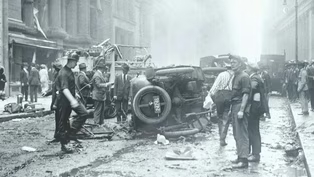
The Bombing of Wall Street: Trailer
Preview: S30 | 30s | The Bombing of Wall Street premieres February 13, 2018. (30s)
Clip: S30 | 1m 17s | During WWII, more than 1,000 women left homes and jobs and became the first females pilots (1m 17s)
Clip: S30 Ep5 | 2m 51s | In 1961, the Freedom Riders were arrested and sent to Mississippi’s Parchman Prison. (2m 51s)
Providing Support for PBS.org
Learn Moreabout PBS online sponsorship




Support for PBS provided by:
Corporate sponsorship for American Experience is provided by Liberty Mutual Insurance and Carlisle Companies. Major funding by the Alfred P. Sloan Foundation.