
Iranians share messages describing life in the midst of war
Clip: 3/16/2026 | 9m 2sVideo has Closed Captions
Iranians share messages describing daily life under the shadow of war
As the U.S. and Israeli war with Iran unfolds, one of the most difficult perspectives to hear has been that of ordinary Iranians because of repressive measures inside the country. Among the 4 million outside Iran, there are deep and bitter divisions over the impact of the war. Special correspondent Leila Molana-Allen spoke with Iranians living inside and outside the country.
Problems playing video? | Closed Captioning Feedback
Problems playing video? | Closed Captioning Feedback
Major corporate funding for the PBS News Hour is provided by BDO, BNSF, Consumer Cellular, American Cruise Lines, and Raymond James. Funding for the PBS NewsHour Weekend is provided by...
Support provided by:

Iranians share messages describing life in the midst of war
Clip: 3/16/2026 | 9m 2sVideo has Closed Captions
As the U.S. and Israeli war with Iran unfolds, one of the most difficult perspectives to hear has been that of ordinary Iranians because of repressive measures inside the country. Among the 4 million outside Iran, there are deep and bitter divisions over the impact of the war. Special correspondent Leila Molana-Allen spoke with Iranians living inside and outside the country.
Problems playing video? | Closed Captioning Feedback
How to Watch PBS News Hour
PBS News Hour is available to stream on pbs.org and the free PBS App, available on iPhone, Apple TV, Android TV, Android smartphones, Amazon Fire TV, Amazon Fire Tablet, Roku, Samsung Smart TV, and Vizio.
Providing Support for PBS.org
Learn Moreabout PBS online sponsorshipGEOFF BENNETT: As the U.S.
and Israel's war with Iran unfolds, one of the hardest perspectives to get has been that of ordinary Iranians because of repressive measures inside that country.
And among the four million outside Iran, there are deep and bitter divisions over the impact of the war.
Special correspondent Leila Molana-Allen spoke with people living in and outside Iran about the war and their hopes and fears about the future.
LEILA MOLANA-ALLEN: As bombs fall and streets burn, a country of 92 million people cut off from the world.
Each morning reveals shattered husks of residential buildings across Iran's densely populated capital, lifeless bodies pulled from the rubble.
A child cries for his mother buried beneath the debris that was their home.
Parents mourn the broken bodies of their children, young and old, voiceless as they contend with the communications blackout imposed by their own government.
But even as the regime appointed a new supreme leader after the killing of his father, they found a way to make their feelings known.
"Death to Mojtaba," they chanted from their balconies.
But the widespread anti-government protests some hoped for have not come.
In brief moments of connectivity, the "News Hour" spoke to Iranians inside the country, who told us their focus right now is survival.
We're keeping them anonymous to protect them from possible reprisals after the Islamic Republic sent messages warning people against speaking out.
We spoke to a young mother in Tehran with a 3-year-old son.
She's taped over her windows and piles cushions around her little boy as he sleeps, trying desperately to keep him safe.
WOMAN (through translator): I can't leave him alone in his room at night.
I go and sleep next to him because I keep thinking that, if something happens, I want to be beside him.
LEILA MOLANA-ALLEN: But she can't protect him from what he can see and hear.
With no access to a shelter, when the airstrikes come, they hide, cowering in their hallway.
WOMAN (through translator): I brought him some samosas to eat.
Suddenly, we heard the sound of fighter jets passing right above us.
It was very frightening.
Then we heard three explosions.
They were so intense that I thought the windows would shatter and be blown into the house.
Now, when I say to my little boy, "Come, I will give you samosas," he says, "I want them, but I don't want the thunder to come again and scare me."
LEILA MOLANA-ALLEN: Families say they stockpiled food, but, as U.S.-Israeli attacks increasingly target infrastructure, they're now terrified the electricity supply will be cut and they will lose what they have.
One man in Tehran told us the bombing is now so intense, it's impossible to hide from.
And everyone lives near the military and government buildings in the bomb sites.
Some people have tried to flee north away from the densely populated downtown, but the roads are packed and gas is scarce.
MAN (through translator): Being bombed is a truly terrifying sound.
No matter how much you feel you're getting used to it, every time you hear it, it haunts you.
LEILA MOLANA-ALLEN: He told us the people have endured so much already.
Now they're trapped between choosing death at the regime's hands or under foreign bombs.
They pray, if they must go through this war too, that it will at least lead to change.
MAN (through translator): What we want is for people to suffer less damage, endure less agony, and for fewer people to be killed.
Ultimately, we want the political outcome that follows to be in the interest of the people, not just for the benefit of politicians or Westerners.
LEILA MOLANA-ALLEN: A lucky few with foreign passports have decided to leave.
The U.N.
says around 1,300 people have left Iran each day via the Turkish border since the war began.
But even beyond Iran, the watchful eye of the Islamic Republic follows.
The "News Hour" spoke with several dissidents who recently escaped Iran.
We're keeping their location secret for their safety.
Shaheen fled last year, but continues to receive threats from regime operatives overseas.
Shortly after he left Iran, anonymous men showed up at his door.
SHAHEEN, Makeup Artist: Sometimes, they send e-mails, direct messages, phone calls, phone calls, and sometimes they do not threat you directly.
They threaten their family and their beloved ones.
They always find a way to silence the people.
It doesn't matter where you are.
LEILA MOLANA-ALLEN: Shaheen says the situation is worse than he's ever seen it, as people endure the bombing under a full Internet blackout.
SHAHEEN: There is no access to the outside world.
There is no freedom of speech.
It was never -- but now it's more restricted and more controlled, with more pressure, with more risk.
LEILA MOLANA-ALLEN: Mahzad is a journalist who fled after being harassed and interrogated for her political writing about Iran's 2022 Woman, Life, Freedom movement.
Now she's watching her country endure hell from afar.
She says it's impossible to overstate how badly traumatized Iran's people are, still reeling from thousands of young protesters being killed by internal security forces just weeks ago and now under daily bombardment.
MAHZAD, Journalist and Activist (through translator): That slaughter that took place in January was like a hell we can never get out of, and the impact it has left on the collective psyche of Iranians I think will last for years, centuries maybe.
LEILA MOLANA-ALLEN: She says it's an experience that unites the Iranian diaspora, deeply divided in other ways, the horror and guilt of watching their countrymen suffer.
MAHZAD (through translator): I couldn't separate myself for a moment from what was happening in Iran, emotionally, psychologically.
In the middle of the night, I would suddenly wake up to check my cell phone.
All I could do was stare at my phone and see how my people were rolling in blood.
I felt totally helpless because I knew how much they were suffering, and I couldn't do anything for them.
LEILA MOLANA-ALLEN: In spite of her anger at the government, Mahzad has determined that war will only lead to more pain and bloodshed.
MAHZAD (through translator): Until we have a practical solution for what comes next, taking out one regime or leader and replacing them with another will lead to the same dictatorship we have been suffering for at least a century.
This is a war in which I see no winner.
LEILA MOLANA-ALLEN: Mehran Kamrava is a professor of government and Iranian studies at Georgetown University in Doha.
An Iranian exile himself, Kamrava has traveled back to the country regularly over the past four decades.
I asked him why there's so little in the way of a defined political opposition inside the country.
MEHRAN KAMRAVA, Georgetown University Qatar: The Islamic Republic succeeded in eliminating any viable opposition.
From 1980 to about 1988, there was a reign of terror in Iran where, people were executed en masse.
Then we have mass repression in the form of people being thrown in jail or people being kicked out.
LEILA MOLANA-ALLEN: Kamrava says his research suggests that, after years of economic stagnation, corruption, repression and violent crackdowns, public support for the regime could have fallen as low as 10 percent.
But that group are ardent supporters, while the majority of the Iranian public has not united around who or what they want to replace it.
MEHRAN KAMRAVA: We do know that the Islamic Republic is not popular among 90 -- 80, 90 percent of Iranians, many of whom are willing to risk their lives to express that opposition, that disgust with the Islamic Republic.
LEILA MOLANA-ALLEN: And, right now, we have Donald Trump saying to the Iranian people, this is your opportunity to rise up and protest and get rid of this government.
Is that something that they are in a position to do while under bombardment?
MEHRAN KAMRAVA: Absolutely not.
Life in Iran now is a daily struggle for survival literally.
It's a struggle for life and death.
There is absolutely no appetite for protest.
Bombs raining from the sky is not help, does not bring democracy, doesn't bring regime change, doesn't bring relief.
It only brings misery and tragedy and death and destruction.
So there is a sense that yet again the United States betrayed Iran.
It betrayed the Iranian people when Donald Trump said help is on its way, and the only thing on its way are B-2 bombers.
LEILA MOLANA-ALLEN: A people attacked on all sides with just one short-term priority, living to see another day.
For the "PBS News Hour," I'm Leila Molana-Allen in Doha, Qatar.
 New
NewAnti-Islamic rhetoric from GOP politicians sparks concerns
Video has Closed Captions
Clip: 3/16/2026 | 8m 5s | Anti-Islamic rhetoric from GOP politicians sparks concerns over religious hatred (8m 5s)
 New
NewA Brief But Spectacular take on the signs of exploitation
Video has Closed Captions
Clip: 3/16/2026 | 2m 29s | A Brief But Spectacular take on the signs of exploitation (2m 29s)
 New
NewMideast experts on Trump’s push to reopen Strait of Hormuz
Video has Closed Captions
Clip: 3/16/2026 | 7m 44s | Middle East experts discuss Trump’s pressure on NATO to reopen Strait of Hormuz (7m 44s)
 New
NewNews Wrap: Chaotic weather system delays U.S. travelers
Video has Closed Captions
Clip: 3/16/2026 | 8m 22s | News Wrap: Chaotic weather system delays U.S. travelers (8m 22s)
 New
NewTamara Keith and Amy Walter on Trump's push for the SAVE Act
Video has Closed Captions
Clip: 3/16/2026 | 8m 7s | Tamara Keith and Amy Walter on the impact of Trump's push for the SAVE Act (8m 7s)
 New
NewTrump demands NATO allies help reopen Strait of Hormuz
Video has Closed Captions
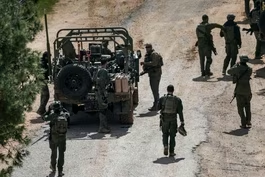
Clip: 3/16/2026 | 4m 43s | As Israel launches Lebanon ground operation, Trump asks allies to help reopen oil route (4m 43s)
 New
NewWhat Trump said about oil prices in call with PBS News
Video has Closed Captions
Clip: 3/16/2026 | 2m 59s | What Trump said about Iran's infrastructure and oil prices in call with PBS News (2m 59s)
Providing Support for PBS.org
Learn Moreabout PBS online sponsorship
- News and Public Affairs

FRONTLINE is investigative journalism that questions, explains and changes our world.

- News and Public Affairs

Today's top journalists discuss Washington's current political events and public affairs.





Support for PBS provided by:
Major corporate funding for the PBS News Hour is provided by BDO, BNSF, Consumer Cellular, American Cruise Lines, and Raymond James. Funding for the PBS NewsHour Weekend is provided by...