
Strange Happenings
Season 9 Episode 11 | 26m 24sVideo has Closed Captions
Life delivers moments that are so strange, so charged, they linger long after they’ve passed.
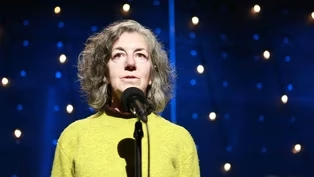
Life delivers moments that defy logic, experiences so strange, so charged, they linger long after they’ve passed. Heidi Johnson is transformed by a profound connection that transcends loss; Paul Geoghegan survives a night when reason falls away and instinct takes over; and Joni Dibrell confronts chilling encounters that challenge everything she believes about death and what lies beyond.
Problems playing video? | Closed Captioning Feedback
Problems playing video? | Closed Captioning Feedback
Stories from the Stage is a collaboration of WORLD and GBH.
Strange Happenings
Season 9 Episode 11 | 26m 24sVideo has Closed Captions
Life delivers moments that defy logic, experiences so strange, so charged, they linger long after they’ve passed. Heidi Johnson is transformed by a profound connection that transcends loss; Paul Geoghegan survives a night when reason falls away and instinct takes over; and Joni Dibrell confronts chilling encounters that challenge everything she believes about death and what lies beyond.
Problems playing video? | Closed Captioning Feedback
How to Watch Stories from the Stage
Stories from the Stage is available to stream on pbs.org and the free PBS App, available on iPhone, Apple TV, Android TV, Android smartphones, Amazon Fire TV, Amazon Fire Tablet, Roku, Samsung Smart TV, and Vizio.
Providing Support for PBS.org
Learn Moreabout PBS online sponsorshipPAUL GEOGHEGAN: To my complete horror and disbelief, I start to see water rising up through what I thought was a solid granite floor.
JONI DIBRELL: We just stood there looking at it.
As if she needed some confirmation, she turns to me and said, "Don't them look like handprints to you?"
HEIDI JOHNSON: I went to bed that night, laying there in the darkness, a pair of eyeballs.
My body was numb.
I couldn't feel anything anymore.
WES HAZARD: Tonight's theme is "Strange Happenings."
♪ ♪ Sometimes, life is filled with twists that logic simply can't untangle.
A coincidence that feels like fate, a mystery that refuses to be solved.
It's at these times that life shows us what is real and what is possible.
Tonight, our storytellers, in moments that are due to fear, weirdness, or are just plain inexplicable, will show us that life is sometimes stranger than fiction.
JOHNSON: My name is Heidi Johnson.
I live in a small town in Massachusetts called Rehoboth.
I grew up there.
I lived in New York for about 30 years, and I recently moved back.
And I'm a painter.
You are a painter.
I'm wondering, how did you first get into that, and, you know, how did that become your main way of expressing yourself?
Well, I've always painted and drawn, and I was super encouraged when I was a kid to pursue these avenues.
I ended up at the Museum School in Boston here, and... it went from there.
And can you just describe your process of taking that inner emotion, feeling, vision, and translating it into something on canvas?
What is that like for you?
JOHNSON: So, how I begin is I make lists and lists and lists of words, and... next to it, the image that I want to be in the painting.
I love that, you know, as a visual artist, that you begin with words.
I think that is fascinating.
I'm wondering, in your preparation for tonight, what did you find most challenging?
Getting through the story without crying, because I haven't... (voice breaking): gone back there in a long time.
Late April, 1979.
I'm 14 years old and standing in the corridor of the pediatric oncology clinic at Rhode Island Hospital.
I'm there because my sister has been diagnosed with pediatric leukemia.
I'm waiting for the bathroom.
I've been waiting a minute.
A knock on the door.
"Just a minute."
Young man's voice comes out.
The door opens.
I'm stunned.
Out walks the most beautiful and energized human being I have ever seen in my entire life.
I can't move, I can't walk, I can't talk.
He's pouring the mysteries of the universe at my feet, rainbows going over my head.
(light laughter) (light chuckle) He giggles.
"Hey," he says, and walks by.
I can't move.
I just turn and follow him down the corridor, where he stops one more time and looks at me and laughs, and walks into his treatment room.
"Heidi, Heidi, Heidi!
Heidi, Heidi!"
I'm being shaken back to reality by the pediatric phlebotomy nurse inches from my face.
I believe she thought I was catatonic, and indeed I was.
(laughter) But I woke with a purpose: I had to find him.
I had a telephone book, I had a road atlas.
I found out his name was Joey Junkin.
I found out he lived in Providence.
That's great, because my grandmother lived in Providence, and we were there three days a week.
I went to the phone book, I found out the address, I went to the road atlas, and bingo!
He lived one block behind my grandmother's house.
Okay.
For the next three months, I walked up and down, up and down, 1,000 times in front of his house.
Did all kinds of errands for the neighbors.
I never saw him once.
(laughter) Dejectedly, I'm standing in the plate glass window of my grandmother's house.
He walks right by.
He doesn't even see me, he doesn't even look at me.
The very next weekend, I put myself right on the sidewalk with a sketchbook and pencils, and pretended to render my grandmother's very boring ranch house.
Within 20 minutes, pay dirt.
He walks up, I'm in heaven.
He recognizes me, we laugh.
He introduces me to his house.
For the next six months, I'm with Joey every weekend at his house.
Absentee father, mother who works all the time.
It's me and Joey and his sister.
We do much of nothing.
I'm 14, he's 17.
We laugh a lot, we watch a lot of silly movies, we listen to a hell of a lot of music.
We had one fumbled kiss in all that time, but we got through it, we got over it.
It wasn't about that.
When I was with Joey, the world was alive.
Every cell in my body was on fire.
When I wasn't with Joey, I was thinking about the next time I would see him.
January 1980.
I had turned 15.
I came in the door from school.
I was wriggling out of my ski jacket.
I look on the table, it's open to The Providence Journal.
It's open to the obituaries.
I walk over and start reading.
My world suddenly goes to gray.
The floor falls away.
(voice breaking): I am reading his obituary.
This is impossible.
I had seen him six days ago.
I was going to see him the very next day.
This grief, this magnitude of grief, I had never known.
I could not explain this to myself, it must be impossible.
I went to bed that night, laying there in the darkness, a pair of eyeballs.
My body was numb.
I couldn't feel anything anymore.
But I knew what I had to do.
I had to find him again.
The very next day, I boarded that rusty Greyhound bus that went between Taunton, Massachusetts and Providence, Rhode Island-- after school, of course-- took it into Providence.
Took the other bus, the city bus, to the stately gates of Swan Point Cemetery, Maxfield Parrish afternoon.
It was golden hour.
Long, golden shafts of light over the snow.
I walked through those gates and I began to walk.
I thought I would see a fresh grave.
Day turned into night.
The streetlights came on.
I was walking from puddle of light to puddle of light.
Pitch black.
I was a little scared.
I saw a pair of headlights begin to snake its way towards me through the monuments.
Car pulls up next to me.
I kept walking.
Smelled cigarette smoke.
Window rolls down.
"Darling, get in the car.
Come on, I gotta close this place up."
I wasn't gonna look.
I kept walking.
40 feet later, I notice it's a cemetery car.
I feel slightly better.
He says, "Darling, come on, get in the car.
"Come on, I'll give you a tour of the cemetery on the way.
I'll introduce you to some of my friends."
I look over, I laugh.
I get in the car.
My hand is on that handle the entire way.
As he's driving back to the gate, he says to me, "Why are you out here, anyway?"
I said, "You know, my friend died, and I thought I could find the grave."
He said, "Oh, hm, okay.
Listen, here's what we'll do.
"I'll take you to the office.
"I will go into the directory, because I can do that.
"I'll find out where he's buried, "and you come back tomorrow, okay?
Sound like a plan?"
I was like, "Yeah, fine, okay."
We drive to the office.
This next part I can't ever explain to anyone with sufficiency.
The car, we park, lights come out of the office through the car window, and suddenly everything is underwater.
Everything is sort of sparkly.
It's vaporous.
I can't... I-- I feel like I'm breathing underwater.
It's fluid.
It's like I'm moving in glycerin.
He says to me... "What's your friend's name, anyway?
I'll go find out."
I said, "My friend, his name-- his name is Joey Junkin."
For 30 seconds, I feel him staring at the side of my head.
I turn to look at him.
He said, "That's my son."
(audience gasps) I sat there.
I did not know what to think.
He said, "I'll take you to him."
He brought me to the most beautiful white marble mausoleum I've ever been in.
It was all too real.
It was the most real... (voice breaking): piece of my entire life.
I spent time in that mausoleum.
Joey was there behind the wall.
I could see it, I could feel it, it was real.
I left the cemetery.
I walked through those gates.
I walked to a pay phone, and I called my mother to come and get me.
But for a very long time, my life did not feel real.
The time I was with Joey felt real.
And those times in the cemetery, I felt very real.
If there's one thing that I learned from Joey, was that you live once.
Life is short.
You have to live with your heart.
You have to live and love fully.
Because when you do, that's when the possibility of magic happens.
Thank you.
(applause) GEOGHEGAN: My name is Paul Geoghegan.
I've lived in New England and Massachusetts my entire life, except for three years of postgraduate education in Texas.
I've worked in the environmental field for my entire life.
Worked in environments all over, from the Great Lakes to the Texas coast, the bayous of Florida, and then a lot of work up here in the Northeast.
After a lifetime of studying nature, what lessons has it taught you about life or yourself?
I would say that it's better to be outside than inside.
There's something in the environment everywhere around you... that you can look at and observe and learn from.
What led you to the storytelling stage?
And specifically, what made you want to share the story that you're sharing this evening?
So, I heard the solicitation on the-- on the radio.
I was driving home.
I said, "I've got a good story I can tell.
Maybe people would be interested in it."
So I kind of combined the spooky theme with an environmental theme in the work I was doing.
And that's how it came out.
It's a hot, humid night in October, the kind of night that makes you think that maybe summer hasn't quite given up yet.
I'm working in Lowell, Massachusetts, an old New England mill town on the Merrimack River.
My job there is to collect water quality samples every hour at the face of a hydroelectric dam.
Water is diverted from the Merrimack River down this old canal to the dam, where there are two hydroelectric turbines that spin and generate electricity.
I'm taking the midnight to 0800 shift because I'm the boss on the project, and I want to show the young guys that I'm willing to do the dirty work.
I'm getting ready for the 0300 sample, and I'm stationed upriver on the canal, in this beautiful, small, old New England mill building.
It's only about 15 by 30 feet, but it has a thick granite floor, solid granite walls, slate roof.
It looks like it would survive a nuclear blast.
I have all my equipment ready in a crate.
Starting to go down, and I hear, but more accurately feel, this low frequency rumble go through my body.
I go, "what's that?
Haven't heard that before."
It passes.
Everything seems to be okay.
All right.
I bend down to pick up my crate of equipment.
As I'm looking down to my complete horror and disbelief, I start to see water rising up through what I thought was a solid granite floor.
I freeze for an instant.
Chill goes through my body, the hair goes up on the back of my neck.
But I know I have to do something.
I don't know what I'm going to do, I have to do something.
I run around the building, I'm picking up equipment off the floor that shouldn't get wet, I'm putting stuff on shelves.
The water is continuing to rise.
I pick up some more stuff, and now the water is knee-deep.
I start thinking, "This is getting scary."
Enough of the equipment, I gotta take care of myself.
I run out of the granite building, and I go up to this catwalk that connects the granite building with the dam.
I go up to a high point on the catwalk.
I look to my left and right.
Look to the left, and where I just came from, out of the granite building, is now underwater.
The approach to the catwalk is underwater.
I look down to my right, and the way down to the dam is also underwater.
And the water is continuing to rise.
You can tell by now I'm not having a good night.
(laughter) But things are about to get really weird.
I peer down through the dark-- through the dim light into the dark water, and I can see now that the river is running... backwards.
I have no understanding of how this is happening.
I'm a scientist.
I like to think that everything can be explained.
But I feel my blood pressure drop, my field of vision narrows, and I almost feel as if I'm watching myself watch the river run backwards.
I step back from the catwalk... and here's the situation: I'm all alone.
It's 3:00 in the morning.
I got flooded out of my building.
I'm on a catwalk.
The water is rising, the river is running backwards, and I'm in an old New England mill.
I might as well be living in a Stephen King novel.
(laughter) But I know I can't panic.
I have to stay in the moment.
There's going to be an explanation, I just don't know what it is.
Panic will only make it worse.
I look to my left and right again, and I can see now the water's dropping.
The approach to the catwalk is clear.
The way down to the dam is clear also.
That's good.
I don't know what happened.
I don't know if it's going to happen again, but it's 3:00, I go to collect the 3:00 sample.
Go down to the dam, collect the samples, get out of there as quick as I can, come up over the catwalk, back into the granite building, and it's wet in there.
Something really did happen.
I have to collect another sample at 0400, and I spend the next hour with one foot in the granite building and one foot on the catwalk in case I have to get out of there again.
4:00 comes.
I go down to the catwalk, go down to the dam, and there's a technician there from the hydroelectric company.
He says to me, "How you doing?"
(laughter) "Okay."
He's working on the control panel, and he says, "Did anything unusual happen?"
(laughter) "Yeah, yes, it did.
"I heard a low-frequency rumble, "I got flooded out of the granite building, "I got stranded on the catwalk with the water rising, then the river ran backwards."
(laughter) He says, "Yeah, that'll happen."
(laughter) "What do you mean, 'that'll happen?'"
He explains, the turbines tripped offline, meaning they stopped turning.
There was no way for the water to get through, but the water continued to come down the canal, hit the face of the dam, rose up, and then formed a wave that then traveled back up the canal.
So it was sort of like a little kid was sloshing back and forth in the bathtub.
So there was a logical explanation for what happened.
I said to the technician, "Wow, I was really scared.
I thought I was in danger there."
He says, "Ah, you weren't in any danger.
"There's an overflow upriver from you that then dumps the water back into the river."
Well, I didn't know that at the time and it was pretty scary.
Back at the dam, it's the next day, and the day crew comes on.
A couple of the younger guys, they're sort of milling about, murmuring among themselves, not really meeting my eye.
A few half-snickers, and finally one of them pipes up and says, "Hey, Paul.
Anything happen last night?"
I looked at him and said, "Yeah, I got a little wet, but it wasn't anything I couldn't handle."
(light laughter) I turned and walked away with a half-smile to myself.
I didn't want them to know just how scared I really was.
Thank you.
(applause) DIBRELL: I'm Joni Dibrell.
I was born and raised in Indianapolis, Indiana, and I now live in Savannah, Georgia.
Wonderful.
And I understand that you had a career in the service, is that correct?
I did.
I spent a lot of years, I spent about 14 years as an officer in the Army.
And when you entered the service, I understand that there weren't, you know, quite so many women in leadership roles.
And I wondered, how did that affect your experience when you started out?
Anytime you break barriers, it's never a smooth transition.
I was the second class of women in ROTC.
Women were not allowed to go to the service academies, et cetera.
So, it was a big change.
And, like anyone else goes in those situations, I met some resistance but managed to get my way through it all.
You're sharing this story with us tonight.
I'm so excited to hear it along with the audience.
But I'm wondering, what led you to choose this story in particular?
Why did you feel that it was important to bring this to the stage?
I tell this story a lot, because there is something that everyone I think can relate to in talking about death and what happens when we die.
I got some very clear messages during my experience, and I share that with other people.
And I always get the same reaction, that people are interested and glad to hear what I'm able to share with them.
I was an army intelligence officer.
My life was dealing with facts and analysis.
And I'm called home one day because my grandfather was critically ill in the I.C.U.
I would go and visit him every day, sit by his bed, mostly watching him sleep.
I came in one day, he was asleep.
I was just ready to sit down when I hear him start to mumble.
I'm looking at him.
He starts to get a little bit louder.
He says, "No, no."
Then he starts rolling around in the bed.
And I can see his head shaking back and forth.
He gets really loud.
"No, no, you can't take me, Satan.
You can't have me, Satan."
What in the world?
I never heard him mention Satan in his life.
What was he seeing?
Should I go out and get a nurse?
Should I wake him up?
I didn't know what to do.
He says this a few more times and he slumps over and goes back to sleep.
I stood there staring at him for the longest time.
What just happened?
I drove home in a daze.
I thought, "where was he?"
I thought we had this gentle passing to the light, and he was obviously in a very dark, scary place.
I didn't even get to talk to him about it.
About a month later, he passed away.
So it left me with this question, and I went on this journey trying to figure out, what are we seeing when we pass?
It's 30 years later.
I'm buying a home in Savannah, Georgia.
It needs renovation.
I hire a team.
They come in, they start their work.
Everything seems to be going pretty well.
The contractor comes and gets me.
She leads me into the kitchen, and she points to a piece of plastic that she had put up just to keep the sheetrock dust out of the other rooms.
And on this plastic that went from the floor up to the ceiling, you can see a small child's handprints that have been dipped in white paint.
About 20 of them.
They're going up to the ceiling.
How does a small child get up to the ceiling?
We just stood there looking at it.
We didn't know what to say.
As if she needed some confirmation, she turns to me and said, "Don't them look like handprints to you?"
(laughter) "Yes, those are handprints."
We had no explanation.
A couple of days later, I'm in the hallway.
One of her workers comes up to me.
He said, "Listen, um... "I can see entities.
There's a little girl in your daughter's room."
Great.
What do I do with that information?
He quits the next day... (laughter) ...so we don't get to talk about that.
And then nothing else happened.
We didn't see anything, we didn't hear anything.
They continue their work, they're finished.
A couple weeks have passed, they're gone.
I'm home alone on a Saturday morning.
My husband is camping with my son.
My daughter's at a sleepover.
It's nice and quiet.
My dog starts to bark.
He's barking furiously.
Now, he's a fat, lazy bulldog.
(laughter) He sleeps.
That's what he does.
I hear these heavy footsteps going up the steps.
Stomp, stomp.
What is my daughter doing home so early?
She just keeps going.
And I'm thinking, "Hm, all right."
I'm lying in bed.
My bed starts to shake.
I'm trying to talk myself out of this.
I'm trying to be rational, analytical.
And then it shakes so much that it jostles me from side to side.
That's it.
I'm out of here.
I jump up.
I'm very scared.
I run up to go get my daughter.
She's not there.
Okay, there's something wrong in this house.
What do I do?
I call a friend of mine who works in the paranormal field.
She tells me, "Well, I know a team of amateur ghost hunters.
I think they can come over and do an investigation."
They come over.
They want to start off in my daughter's room.
They're up there.
The head of the team, David, he's talking through one of the monitors, and he gets a child's voice, and they're talking, but it's a very short conversation.
He grabs the monitor, he flips it off.
I said "What-- what's wrong?"
"Well, I think there's a dark entity "that has come in with the little girl.
We don't want to release that into the room."
I'm thinking, "No, we don't."
(laughter) So, I start walking through, and my husband's in his study, and he's talking to someone that we later knew had passed away.
I go to the master bedroom.
David's up there now, and he's talking to a very angry entity who comes through the monitor and says, "David is a...
butthole."
(laughter) The, the other word.
He says it two more times.
I'm standing there thinking, "How did we get here?"
(laughter) I've seen the physical manifestations.
I've seen the handprints.
My bed has been shaken.
Now I can hear voices.
They're getting ready to go, but they decide they want to go up one more time to my daughter's room and see if they can make contact with the little girl.
The psychic sits across from my daughter, begins talking, and says, "We're going to try to send the little girl to the light."
She starts talking and says, "She's here."
And my daughter says, "Yes, I can feel her hand on my shoulder."
She starts to talk.
"Honey, can you see your mommy?
Can you see your daddy?
You need to go to the light.
Go to the light."
She says this over and over, and I see a tear start to fall down my daughter's cheek.
She opens her eyes.
She says, "She's gone."
And the psychic said, "Yeah, she's gone."
We go downstairs.
Standing on the porch, David tells me they're going to look at all the tapes.
They're going to analyze everything.
They'll get back to me.
Great.
I'm not at all prepared for what happens to me next.
All my years in the army, whatever analytical work I did, I taught at the university.
I can now see entities.
I see a man standing in the door of my bedroom.
I see a little girl standing at the foot of my bed.
It terrifies me every time it happens.
I call the team back.
I need help.
They come back, and with them they bring a short, little petite lady.
Her name is Maria.
"What does Maria do?"
"Well, Maria can handle dark entities."
Good.
Maria starts walking around my house.
She's burning sage, she's doing a cleansing process.
When she finishes with the cleansing, she comes over, she sits down beside me, and she sincerely asks me, "Joni, would you like to know what happens to you when you die?"
"Yes."
"You're going to go through a dark tunnel.
"It's going to get very dark.
"You're going to be afraid.
"Don't be afraid.
You need to keep going.
"And when it gets really dark, "you're going to see a pinhole of light.
"It's going to get bigger and bigger "until you're engulfed by the light.
"That's where you're supposed to be.
"What we're dealing with here in your house "are those that have turned around.
Don't turn around.
Keep going."
Got it.
We go out on the porch.
David tells me, "Um... look, when I came up here, "I knew the house was not good, "but it's good now.
It's okay.
"However, I have to tell you, I think they're out in the garden shed."
(laughter) Okay, they can have the garden shed.
That's fine.
Nothing else happened.
The house was good.
We didn't have any-- We didn't see anything else, we didn't hear anything else.
And I found myself a lot of times thinking about my grandfather being in that very dark place.
I think about him every day.
I have his signature tattooed on my wrist, and I hope he made it to the light.
I think about my own passing.
I think about when you go through that dark place and you are afraid, will I be able to see the light?
And most of all, I want to really remember what Maria said to me.
"Keep going."
Thank you.
(applause) ♪ ♪
Video has Closed Captions
Preview: S9 Ep11 | 30s | Life delivers moments that are so strange, so charged, they linger long after they’ve passed. (30s)
Providing Support for PBS.org
Learn Moreabout PBS online sponsorship

- Arts and Music

Innovative musicians from every genre perform live in the longest-running music series.




Support for PBS provided by:
Stories from the Stage is a collaboration of WORLD and GBH.