
Midwife’s death highlights racial gap in maternal mortality
Clip: 1/15/2026 | 7m 3sVideo has Closed Captions
Black midwife’s death highlights racial gap in maternal mortality
The death of a Black midwife following complications from giving birth has renewed difficult questions surrounding inequities in Black maternal health care. Black women are still three times more likely to die from a pregnancy-related cause than white women. Stephanie Sy reports.
Problems playing video? | Closed Captioning Feedback
Problems playing video? | Closed Captioning Feedback
Major corporate funding for the PBS News Hour is provided by BDO, BNSF, Consumer Cellular, American Cruise Lines, and Raymond James. Funding for the PBS NewsHour Weekend is provided by...
Midwife’s death highlights racial gap in maternal mortality
Clip: 1/15/2026 | 7m 3sVideo has Closed Captions
The death of a Black midwife following complications from giving birth has renewed difficult questions surrounding inequities in Black maternal health care. Black women are still three times more likely to die from a pregnancy-related cause than white women. Stephanie Sy reports.
Problems playing video? | Closed Captioning Feedback
How to Watch PBS News Hour
PBS News Hour is available to stream on pbs.org and the free PBS App, available on iPhone, Apple TV, Android TV, Android smartphones, Amazon Fire TV, Amazon Fire Tablet, Roku, Samsung Smart TV, and Vizio.
Providing Support for PBS.org
Learn Moreabout PBS online sponsorshipAMNA NAWAZ: The death of a Black midwife following complications from giving birth has renewed difficult questions about inequities around Black maternal health care.
Black women are still at a considerably higher risk to die from a pregnancy-related cause than white women.
Stephanie Sy has more on this story.
STEPHANIE SY: Janell Green Smith, 31, was laid to rest in Spartanburg, South Carolina, this week.
Her death sent shockwaves through the community of Black midwives, which include her aunt, Nichole Wardlaw.
What do you think people will remember most about Janell?
NICHOLE WARDLAW, Aunt of Janell Green Smith: They talked about her being the friend that was the glue that held everything together, that she showed up for people, that she -- just her presence.
She had a big presence.
STEPHANIE SY: This is Green Smith in April 2024.
JANELL GREEN SMITH, Midwife: I wanted to be a part of the solution and step into a role as the provider that would listen to my patients when they said they were in pain.
I wanted to be the provider that would answer the questions and that would go above and beyond to allow my patients to feel comfortable in their journey of pregnancy and in labor.
NICHOLE WARDLAW: The patients loved her, that she would show up for them.
She loved on them.
I remember someone talking about how she was just always asking, why, why is this, why is that, that she wanted to know the why and make things better.
STEPHANIE SY: That's the question I keep asking myself, is, why?
She had so much knowledge.
She was an experienced midwife.
Why did this happen?
NICHOLE WARDLAW: It was the perfect storm.
She was pregnant.
She developed preeclampsia, but she never stopped working, fighting, showing up.
She showed up.
She had a shift the day before she was admitted to the hospital herself.
She worked 12 hours and caught seven babies.
So she showed up for clients and did the work, even though she herself really needed to be cared for.
So, as a midwife, who midwives the midwife?
STEPHANIE SY: Wardlaw says Green Smith herself didn't have a midwife because there weren't other practices in the area that took her insurance.
In the United States, Black women are three times more likely to die from a pregnancy-related cause than white women.
WOMAN: There's a foot.
STEPHANIE SY: Integrating midwives into maternal care has been shown in studies to decrease maternal deaths.
Jessica Brumley is president of the American College of Nurse Midwives.
JESSICA BRUMLEY, President, American College of Nurse Midwives: Black women are at higher rates of Caesarean section, at higher rates of preeclampsia.
They have higher rates of almost every possible comorbidity or complication that an individual can have.
They're more likely to seek care in systems of care that are not high-quality.
And we know that standardized care and care practices can help to improve outcomes.
STEPHANIE SY: Do we know why Black women are more susceptible to preeclampsia in pregnancy?
JESSICA BRUMLEY: The chronic stress, the generations of chronic stress, the different exposures to racism in this country, and all of that adds and creates what is known as weathering, right?
And so it makes it more difficult to manage these conditions in individuals who've had these exposures.
STEPHANIE SY: There's no cure for preeclampsia, but it can be resolved once the baby is born.
Green Smith underwent an emergency Caesarean section, which carries its own risks.
NICHOLE WARDLAW: Her incision opened up, and so they had to take her back to the operating room to close the incision.
And it was after that operation that during the recovery period there were complications, and that ultimately contributed to her death.
STEPHANIE SY: Explain to us how is it that Black women are still so much more vulnerable to dying of pregnancy-related causes than other women?
JESSICA BRUMLEY: This is a really complex issue, but I think that it comes down to the fact that the system is designed to create these outcomes.
We get the outcomes that the system is designed for.
And when we think about historically where our system has come from, it came from centering childbirth into the hospital, away from the community, away from the people who cared for us, right, our community-based midwives, Black granny midwives, and that nurturing environment into an environment that wasn't welcoming and still isn't often very welcoming for Black women in our country.
NICHOLE WARDLAW: I don't know if it was professional courtesy, that the assumption was just made that she knew all of the things and would be able to take care of herself.
I don't know if there were expectations of her that wouldn't be expectations of other people, but what I do know is that she's not coming back and we never want this to happen to anybody else.
STEPHANIE SY: Brumley says gaps in postpartum care in the U.S.
don't just harm Black women.
JESSICA BRUMLEY: So if we can design a system where Black women have the best outcomes, everyone else will have better outcomes too, because even though Black women have some of the worst outcomes in the U.S., the U.S.
has some of the worst maternal health outcomes in the world.
So white women aren't doing much better in this country.
We have to think about, how do we change what we offer and offering a service that people think is valuable?
No one should have to fear for their life in order to grow their family.
And I don't think it's fair that people should lose the joy of what should really be an amazing, beautiful life event.
STEPHANIE SY: Janell got to experience some of that joy, holding her daughter Eden if only for a short while.
Born premature, Eden is still in the hospital.
NICHOLE WARDLAW: Eden is doing great.
She's thriving.
She's growing.
She's meeting her milestones.
She is the feistiest little fighter.
She has her mother's spirit.
STEPHANIE SY: For the "PBS News Hour," I'm Stephanie Sy.
3D scanning of classic works of art raises ethical questions
Video has Closed Captions
Clip: 1/15/2026 | 6m 46s | 3D tech preserves and reproduces masterpieces, raising ethical questions (6m 46s)

How Trump's attack on wind power is impacting the industry
Video has Closed Captions
Clip: 1/15/2026 | 8m 4s | How Trump's attack on wind power is impacting the energy industry (8m 4s)
The Insurrection Act's powers as Trump threatens to use it
Video has Closed Captions
Clip: 1/15/2026 | 5m 52s | What is the Insurrection Act? Explaining its powers as Trump threatens to use it (5m 52s)
Machado meets Trump amid Venezuelan leadership uncertainty
Video has Closed Captions
Clip: 1/15/2026 | 8m 45s | Machado presents Trump her Nobel Prize as uncertainty surrounds Venezuela’s leadership (8m 45s)
Mental health, addiction funding restored after backlash
Video has Closed Captions
Clip: 1/15/2026 | 6m 9s | White House slashes, then restores, funding to treat mental health and addiction (6m 9s)

Minnesota protests escalate as Trump intensifies threats
Video has Closed Captions
Clip: 1/15/2026 | 4m 15s | Minnesota leaders call for calm as protests escalate and Trump intensifies threats (4m 15s)
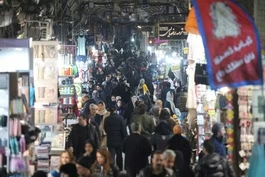
News Wrap: U.S. places new sanctions on Iranian officials
Video has Closed Captions
Clip: 1/15/2026 | 5m 51s | News Wrap: U.S. places new sanctions on several Iranian officials (5m 51s)
Providing Support for PBS.org
Learn Moreabout PBS online sponsorship
- News and Public Affairs

FRONTLINE is investigative journalism that questions, explains and changes our world.

- News and Public Affairs

Today's top journalists discuss Washington's current political events and public affairs.





Support for PBS provided by:
Major corporate funding for the PBS News Hour is provided by BDO, BNSF, Consumer Cellular, American Cruise Lines, and Raymond James. Funding for the PBS NewsHour Weekend is provided by...