
January 15, 2026 - PBS News Hour full episode
1/15/2026 | 56m 46sVideo has Closed Captions
January 15, 2026 - PBS News Hour full episode
January 15, 2026 - PBS News Hour full episode
Problems playing video? | Closed Captioning Feedback
Problems playing video? | Closed Captioning Feedback
Major corporate funding for the PBS News Hour is provided by BDO, BNSF, Consumer Cellular, American Cruise Lines, and Raymond James. Funding for the PBS NewsHour Weekend is provided by...
January 15, 2026 - PBS News Hour full episode
1/15/2026 | 56m 46sVideo has Closed Captions
January 15, 2026 - PBS News Hour full episode
Problems playing video? | Closed Captioning Feedback
How to Watch PBS News Hour
PBS News Hour is available to stream on pbs.org and the free PBS App, available on iPhone, Apple TV, Android TV, Android smartphones, Amazon Fire TV, Amazon Fire Tablet, Roku, Samsung Smart TV, and Vizio.
Providing Support for PBS.org
Learn Moreabout PBS online sponsorshipGEOFF BENNETT: Good evening.
I'm Geoff Bennett.
AMNA NAWAZ: And I'm Amna Nawaz.
On the "News Hour" tonight: The president# threatens to d.. Minneapolis in response to protests# against his immigration crackdown.
GEOFF BENNETT: Venezuela's opposition leader# strikes a positive tone after a meeting with## President Trump that could have far-reaching# implications for her country's future.
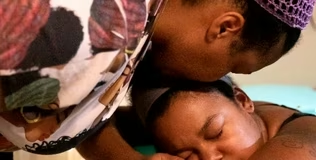
AMNA NAWAZ: And the death of a Black# midwife just days after giving birth## by a Caesarean section renews questions# about disparities in maternal health care.
JESSICA BRUMLEY, President, American# College of Nurse Midwives: Black women## are at higher rates of Caesarean .. higher rates of almost every# possible comorbidity or complication.
(BREAK) AMNA NAWAZ: Welcome to the "News Hour."
Protesters clashed with ICE agents# in Minneapolis again today after## a man was shot and wounded when he# allegedly assaulted federal officers.
GEOFF BENNETT: Minneapolis Mayor Jacob Frey called# for calmer reactions on the street.
That's as## President Trump is threatening to deploy U.S.# troops to the Twin Cities to quell the protests## there.
And the state's governor, Tim Walz, is# asking the president to lower the temperature.
Special correspondent Fred de Sam Lazaro starts## our coverage with what's unfolded# over the last 24 hours in Minnesota.
(SHOUTING) FRED DE SAM LAZARO: This morning, new threats# from President Trump of heavier interv.. this after protests broke out# in Minneapolis again overnight.
On social media, Trump warned he'd use the# Insurrection Act.
That's the 18th century power## of the president to deploy the U.S.
military# if the president decides local authorities## cannot maintain order.
It was last used in 1992# during the Rodney King riots in Los Angeles.
Minnesota's Attorney General Keith Ellison said# he's ready to go to court if it's invoked.
It## all came just after the dust settled from# overnight scenes like this.
Crowds gathered## after an ICE agent shot of Venezuelan national# in the leg during a targeted traffic stop.
Administration officials alleged# the man and two others attacked## the agent with a shovel and a# broom handle -- is dialing up## the temperature after the fatal shooting# of 37-year-old Renee Goode one week ago.
BRIAN O'HARA, Minneapolis, Minnesota, Police# Chief: The crowd is engaging in unlawful acts.
FRED DE SAM LAZARO: At a# late-night press conference,## the city's police chief said yesterday# went too far when protesters hurled rocks## and fireworks at law enforcement.# Mayor Jacob Frey called for calm.
JACOB FREY (D), Mayor of Minneapolis, Minnesota:# And for anyone that is taking the bait tonight,## stop.
That is not helpful.# Go home.
We cannot counter## Donald Trump's chaos with our own brand of chaos.
FRED DE SAM LAZARO: Minnesota Governor Tim Walz: GOV.
TIM WALZ (D-MN): As hard as we will# fight in the courts and at the ballot box,## we cannot and will not let violence prevail.
FRED DE SAM LAZARO: In Washington today,# PBS News' Liz Landers asked the White## House if President Trump is working# with the governor to de-escalate.
LIZ LANDERS: Governor Walz's office# is saying today that he's trying to## get ahold directly with the# president.
Have you spoken?
KAROLINE LEAVITT, White House Press Secretary:# Look, the president is always willing to## answer the phone when people pick up and# call.
But I would ask that the governor## stops inciting the harassment and illegal# obstruction of law enforcement in his state.
FRED DE SAM LAZARO: Homeland# Security Secretary Kristi Noem said,## Insurrection Act or not, ICE isn't going anywhere.
KRISTI NOEM, U.S.
Homeland Security# Secretary: Remember, we are there## in surged operations because of the# largest frau.. FRED DE SAM LAZARO: Trying to tie the crackdown# to Minnesota's welfare fraud scandal.
Separately,## the president himself has# threatened to defund states## with so-called sanctuary cities# that include the Twin Cities.
For many, it's as if ICE is around every# corner.
Locals have spotted arrests as## their kids board the bus to school# and in random I.D.
checks.
Secretary## Noem today said people should carry# I.D.
to confirm their legal status,## something not legally required of U.S.# citizens except in circumstances like travel.
QUESTION: Are you OK with federal# agents and officers violating people's## Fourth Amendment rights by asking for# papers without reasonable suspicion?
KRISTI NOEM: Every single action that# our ICE officers take is according to## the law and following protocols# that we have used for years.
FRED DE SAM LAZARO: Meantime, schools in# the area are reporting a sharp drop in## attendance and several districts will soon# offer students the option to attend online.
For the "PBS News Hour," I'm Fred# de Sam Lazaro in Minneapolis.
GEOFF BENNETT: President Trump's threat to# invoke the Insurrection Act is sparking concern## among critics, who warn that the law's# sweeping powers make it easy to misuse,## especially in moments of domestic unrest.
To help us understand what's at stake, we're# joined now by Elizabeth Goitein, senior## director of the Liberty and National Security# Program at the Brennan Center for Justice.
Thank you for joining us.
ELIZABETH GOITEIN, Brennan# Center for Justice: My pleasure.
GEOFF BENNETT: Based on Presid.. how seriously should we take the prospect that# he might actually invoke the Insurrection Act?
ELIZABETH GOITEIN: I think# we need to take it seriously.
He has certainly threatened to invoke# the Insurrection Act in the past,## but this is coming on the heels of a# Supreme Court decision that rejected## his efforts to use a different law to# deploy the military in U.S.
cities,## but that left open the possibility# of using the Insurrection Act.
And so I think in the wake of this sort of# defeat that he faced in his attempts to deploy## the military elsewhere, he might be looking# for an opportunity to show that he can still## make good on his threats to use the military as# a domestic police force inside the United States.
GEOFF BENNETT: And, practically# speaking, how would he do it?
ELIZABETH GOITEIN: Well, under the Insurrection# Act, he would issue a proclamation.
And then he## would have the authority, at least unless# the courts held that he didn't, to deploy## either active duty troops or to federalize the# National Guard and deploy National Guard forces.
And under the Insurrection Act,# he can, at least in theory,## use them to conduct law enforcement# activities.
So the Insurrection Act## is generally considered to be an exception to# the Posse Comitatus Act, and that's the law## that normally prohibits federal armed forces# from engaging in civilian law enforcement.
GEOFF BENNETT: How often has the Insurrection# Act been used and in what situations?
ELIZABETH GOITEIN: It's been used very sparingly.
And I should say that even though the law on its# face is written in vague and archaic language## that seems to give the president quite a bit of# discretion, the Department of Justice has long## interpreted it more narrowly and has opined# that it should only be used as a last resort.
And in keeping with that approach, presidents# have invoked the Insurrection Act only about## 30 times in our nation's history.
And in# virtually every one of those instances,## either a governor requested assistance# because state and local law enforcement were## completely overwhelmed, or the state itself was# actively obstructing federal civil rights laws.
GEOFF BENNETT: If a president were to# deploy federal troops to a state like## Minnesota over the objections of# the governor and local officials,## what would that mean legally?
Where does# state authority end federal power begin?
ELIZABETH GOITEIN: Well, the president# has the authority to federalize National## Guard forces and remove them from state# command-and-control when authorized by statute.
And so, if he invoked the Insurrection Act, he# would take command-and-control of the National## Guard.
Now, the states could file challenges# in court and could argue, and I think they## would have a strong case, that the president was# exceeding his authority under the Insurrection## Act and that the actions of the military were# in fact violating the Posse Comitatus Act.
In that case, a court could enjoin# the president's use of troops.
But## in the initial invocation of the act,# the president does have the authority## to assert command-and-control over# federalized National Guard forces.
GEOFF BENNETT: So why, in your view, would# this be an illegitimate use of the act?
ELIZABETH GOITEIN: Well,# there is chaos in Minneapolis,## but it is chaos that is of the# federal government's own making.
The vast majority of the violence and lawlessness# in Minneapolis is coming from ICE.
And the purpose## of invoking the Insurrection Act would not# be to quell that violence and lawlessness.## It would be to enable it.
That is clearly# an illegitimate use of the Insurrection Act.
And, more than that, it would set# an incredibly dangerous precedent.
GEOFF BENNETT: And that plays# into what critics argue,## that the deployment of these ICE agents to# Minneapolis and the protests it sparked,## that this was all just a test case to justify# invoking the Insurrection Act and potentially## deploying the military to Democratic-led cities in# this election year, that was the plan all along,## that immigration enforcement was really# just a pretext, to which you would say what?
ELIZABETH GOITEIN: Well, the president# has certainly been very clear that he## does not view the use of the military in U.S.# cities as a last resort.
He actually has said## that he thinks that U.S.
cities should be# training grounds for the U.S.
armed forces.
And if you look at the last# nine presidencies combined,## not including the first Trump# administration, presidents have## deployed troops to quell civil unrest or enforce# the law only twice.
President Trump has deployed## troops or requested or attempted deployment of# troops seven times in his first year in office.
So he certainly intends to use the# military very differently from the## way the presidents have used it# in the past and the way that the## law has been interpreted to permit# the use of the military in the past.
GEOFF BENNETT: Elizabeth Goitein# with the Brennan Center for Justice,## thanks again for your time this evening.
ELIZABETH GOITEIN: Thanks for having me.
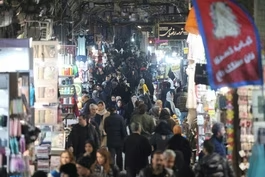
AMNA NAWAZ:## We start the day's other headlines in Iran,# where a bloody regime crackdown looks to have## rained in widespread protests, even as# the threat of U.S.
intervention remains.
President Trump has signaled# an interest in de-escalation,## though he hasn't ruled out military action.
KAROLINE LEAVITT, White House Press# Secretary: The president and his team## are closely monitoring this situation, and all# options remain on the table for th.. AMNA NAWAZ: White House Press Secretary# Karoline Leavitt said the president was told## by Tehran that some 800 scheduled executions# of protesters had been halted.
But, today,## the Trump administration placed# new sanctions on several Iranian## officials they described as being the# architects of the attacks on protesters.
At the U.N.
today, U.s.
ambassador Michael Waltz## condemned Iran for claiming that# the protests were a foreign plot.
MICHAEL WALTZ, U.S.
Ambassador to the# United Nations: Regardless of its excuses,## and you will hear many today from the# Iranian regime and from its friends,## the regime is solely, solely responsible for# the economic misery of the Iranian people## and the repression of their freedom,# and they will be held accountable.
AMNA NAWAZ: A U.S.-based human# rights group says at least 2,600## protesters have been killed by state# forces.
Iran remains largely shut off## from the world as a state-imposed# Internet blackout remains in place.
European troops have begun arriving# in Greenland after talks in Washington## failed to make progress on President# Trump's push to take over the territory.## Danish Air Force troops landed late last# night, and NATO partners, including France,## Germany and others, are sending# small numbers of forces as well.
This comes after the Danish foreign minister# set a fundamental disagreement over Greenland## remains after meeting with American officials# at the White House.
Greenland residents say## they are relieved to have the support from# allies, but worry about what comes next.
BIRGER POPPEL, University of Greenland: I don't# think facts affect Trump.
And, to be honest,## as it seems right now, the major threat to# security in Greenland comes from our U.S.
allies.
AMNA NAWAZ: The White House said today# that the presence of new European## troops in Greenland would not affect President# Trump's position on taking over the territory.
Federal prosecutors are charging 26# people for allegedly rigging NCAA and## Chinese basketball association games;# 15 of those charged played Division I## basketball as recently as last season.# The charges include wire fraud, bribery## and conspiracy.
In a press conference today,# authorities said fixtures paid players up to## $30,000 a game to deliberately underperform,# then placed large bets against their teams.
U.S.
attorney David Metcalf says those## involved -- quote -- "poisoned the American# spirit of competition from monetary gain."
DAVID METCALF, U.S.
Attorney, Eastern# District of Pennsylvania: When criminals## pollute the purity of sports by manipulating#.. integrity of sports betting markets.
It# imperils the integrity of sport itself.
AMNA NAWAZ: The indictment claims that# fixers and players tried to rig 29 games## across multiple seasons involving millions# of dollars in bets.
It comes after a series## of NCAA investigations that have led to at# least 10 players receiving lifetime bans.
A federal appeals court today opened the# possibility that Palestinian activist## Mahmoud Khalil could be rearrested and# possibly deported.
The three-judge panel## reversed a lower court decision# that led to his release last June,## saying it didn't have jurisdiction.
They added# that Khalil -- quote -- "will have to wait## to seek relief from allegedly# unlawful government conduct."
The former Columbia University graduate student# is a permanent resident whose wife and son are## American.
His case became a high-profile# example of the Trump administration's## crackdown on pro-Palestinian activities on# campus.
His lawyers say they plan to appeal.
Four astronauts are safely back on Earth after## NASA's first medical evacuation of# the International Space Station.
WOMAN: Splashdown of Crew-11.
AMNA NAWAZ: The crew touched down in# the Pacific near San Diego early this## morning.
They ended their mission more than a# month early because one of the astronauts was## experiencing an undisclosed medical condition.
The# astronaut has not been named for privacy reasons.## All four were taken for medical checks# when they landed, as is standard procedure.
NASA and SpaceX officials# say they're working to move## up the launch of the next crew# currently set for mid-February.
On Wall Street today, stocks posted# decent gains, thanks largely to a## rebound in A.I.-related shares.
The Dow Jones# industrial average gained nearly 300 points.## The Nasdaq rose about 50 points on the day.# The S&P 500 snapped a two-day losing streak.
And the U.S.
Postal Service revealed a new stamp# today featuring boxing legend Muhammad Ali.
(APPLAUSE) AMNA NAWAZ: The unveiling took place in# his hometown of Louisville, Kentucky.
The## stamp features a photo of Ali from 1974# with his last name in bold letters.
The## Postal Service has printed 22 million of the# Ali Forever Stamps which went on sale today.
The three-time heavyweight champ once# joked that he should be on a stamp someday,## because, as he put it, that's the# only way I will ever get licked.
Still to come on the "News Hour":# the confusion caused by a slashing,## then restoration of mental health# and addiction funding;the White House## targets wind power projects, putting# energy businesses in jeopardy;and## a cutting-edge 3-D scanning technology# helps to replicate classic works of art.
GEOFF BENNETT: Today, Nobel peace laureate# Maria Corina Machado met with President## Trump and said she presented him her Nobel# Peace Prize.
Their lunch came after the## president spoke yesterday to Venezuela's# acting president, a woman who in the past## disparaged Machado and is now empowered by# the Trump administration to lead that country.
Nick Schifrin examines the country's# current and would-be leadership.
NICK SCHIFRIN: In Washington today,# the woman who won a Nobel Peace Prize## for advocating democracy brought her prize# to the man she says can deliver democracy.
MARIA CORINA MACHADO, Venezuela# Opposition Leader: I presented## the president of the United States# the medal of the Peace -- Nobel## Peace Prize as a recognition for his# unique commitment with our freedom QUESTION: Ms.
Machado, how did# your meeting go with the president?
NICK SCHIFRIN: Machado met with bipartisan# senators who call her Venezuela's rightful## leader.
Whether she one day becomes# that, she said today was up to Trump.
MARIA CORINA MACHADO (through# translator): Know that we count## on President Trump for the freedom of Venezuela.
NICK SCHIFRIN: It was two years ago that# Machado was banned from running for president,## but she handpicked a candidate, Edmundo Gonzalez,## who defeated then-President Nicolas Maduro# by 2-1, according to the opposition's tally.
And on his third day as secretary of state,## Marco Rubio called Gonzalez Venezuela's# -- quote -- "rightful president" and## reaffirmed the United States' support for# the restoration of democracy in Venezuela.
But then the U.S.
captured Maduro and,## faced with a decapitated Venezuelan# regime, Machado was sidelined.
DONALD TRUMP, President of the United States:# She doesn't have the support within or the## respect within the country.
She's a very# nice woman, but she doesn't have the respect.
NICK SCHIFRIN: So, instead,## the Trump administration .. DONALD TRUMP: We just had# a great conversation today,## and she's a terrific person.
I mean, she's# somebody that we have worked with very well.
NICK SCHIFRIN: But Rodriguez was Maduro's# handpicked deputy.
Most recently,## she oversaw the oil industry, but# activists accuse her of helping hand## over the country's security and economy# to American adversaries Cuba and Iran.
And she was, for decades, a follower of the# country's nationalist Chavismo leadership.
DELCY RODRIGUEZ, Acting President of Venezuela# (through translator): And here we are,## the peoples, dozens and hundreds who came# together here, pre.. that there is no way they can subdue us# or subject us to their imperial orders.
NICK SCHIFRIN: Recently, she's proved open to# working with the country she used to call the## imperialists, releasing 70 political# prisoners, including five Americans,## and opening up the world's largest# oil reserves to American investment.
But activists say she cannot deliver the# rule of law that U.S.
investment requires,## and they say she cannot be trusted.
For the "PBS News Hour," I'm Nick Schifrin.
GEOFF BENNETT: And we turn now to Laura Dib,## director of the Venezuela Program at# the Washington Office on Latin America.
Thank you for being here.
We appreciate it.
LAURA DIB, Venezuela Program Director,# Washington Office on Latin America: Thank you.. much for your invita.. GEOFF BENNETT: Maria Corina Machado# is wrapping up day.. visit to Washington.
How should we assess# her visit and her meeting with President## Trump and other U.S.
policymakers,# what it says about her standing?
LAURA DIB: After she had been dismissed by# President Trump on January 3, after his remarks,## right after the strike, he said that she# didn't have the support of Venezuelans.
So there was a lot of concern among members# of Venezuelan civil society that Venezuelans## were being left out of the decision-making# process around the future of Venezuela,## and that their agency was being undermined.# So I think that the fact that President Trump## met with Maria Corina Machado, but# also a group of bipartisan senators,## is a good sign that they're listening# to members of the Venezuelan opposition.
GEOFF BENNETT: How much influence# does she have in Venezuela right now?
LAURA DIB: It's hard to have influence# when you're dealing with an authoritarian## government.
Between Chavez and# Maduro, they ruled for 26 years.## So I would understand also the concern from# the administration that she -- even though## she has popular support, she has limited# capacity to whole power in this context.
GEOFF BENNETT: And you have noted# that Edmundo Gonzalez won roughly## 67 percent of the vote with her backing.
If# that level of support exists within Venezuela,## what is the missing piece that# prevents real political change?
LAURA DIB: Authoritarianism.
I mean, Venezuelans have committed themselves to# fighting for.. I mean, five different rounds of# negotiations, peaceful demonstrations,## participated in elections despite# the lack of free and fair election## conditions.
The Carter Center, the# U.N.
panel of experts have said this.
Maria Corina Machado was banned from running for# office, just as other members of the opposition.## So it was impossible for the opposition and# for civil society to mobilize and actually## exercise power when Maduro,after that election,# decided to hang on to power through repression.
And one thing I would notice is, after Maduro was# taken, there has been silence in the streets.
And## a lot of people are wondering, well, if he# was so unpopular, why are the streets empty?## And the answer to that question is the brutal# repression that came afterwards; 2,000 people## were detained.
Just today, around 1,000 remained# detained.
People were killed in the streets.
So people are very much afraid of# going out and speaking out their minds.
GEOFF BENNETT: So, on that point,# how should we understand the interim## president, Delcy Rodriguez, within the# current power structure in Venezuela?
LAURA DIB: Delcy Rodriguez has# been a member of the government## since the beginning of Chavez.
I mean,# she has held different positions.## She was a minister of oil.
That's important# because she has a relationship with the## private sector that other members within# the Chavismo government didn't have.
And she was the vice president under Maduro.
She# was also the minister of foreign affairs at some## point.
But given all of these conditions, one has# to wonder whether she will actually be the one## that opens some doors towards democratization.# So far, that doesn't seem to be the case.
GEOFF BENNETT: If there is no political# transition and if repression continues, does## Venezuela realistically become a place where major# oil companies, to include U.S.
firms, can invest?
LAURA DIB: The meeting that President Trump held# with some of these oil companies was very telling,## because, for example, ExxonMobil,# who is owed billions of dollars,## said that Venezuela was uninvestable# because there needed to be a change.
And I think that's a clear message also# that oil companies should send.
It is## impossible to invest without a certain# rule of law and legal certainty.
You## can't invest in a country where# there are no democratic openings.
The reality is that -- and I think# that's something that not only the U.S.,## but other countries, democratic countries, should# be sending the message that, in order for the## complex humanitarian emergency in Venezuela# to be reverted, there needs to be some sort of## democratic opening.
This cannot just be a change# in actors without a real democratic transition.
GEOFF BENNETT: Is there a realistic# pathway where economic engagement## could actually create pressure for# democratic openings in Venezuela?
LAURA DIB: I believe that should# be the case.
And I think that,## sadly, we have seen how the# administration is more driven## by economic interests than it is about the# concern for human rights and for democracy.
The national security strategy that the# administration published doesn't mention the word## human rights, not even once.
So this is a context# in which realistically, and from a pragmatic## standpoint, then these economic actors have the# potential to actually create those openings.
But I also have the responsibility to say# that all the literature, all the research## on transitional justice explains how no process of# democratic transition can be sustainable without## the participation of civil society.
And this is# something that is definitely lacking right now.
GEOFF BENNETT: Laura Dib, thanks again for# your time this evening.
We appreciate it.
LAURA DIB: Thank you.
Thank you so much.
AMNA NAWAZ:## The death of a Black midwife following# complications from giving birth has## renewed difficult questions about inequities# around Black maternal health care.
Black women## are still at a considerably higher risk to die# from a pregnancy-related cause than white women.
Stephanie Sy has more on this story.
STEPHANIE SY: Janell Green Smith, 31, was# laid to rest in Spartanburg, South Carolina,## this week.
Her death sent shockwaves# through the community of Black midwives,## which include her aunt, Nichole Wardlaw.
What do you think people will# remember most about Janell?
NICHOLE WARDLAW, Aunt of Janell# Green Smith: They talked about## her being the friend that was the# glue that he.. that she showed up for people, that she --# just her presence.
She had a big presence.
STEPHANIE SY: This is Green Smith in April 2024.
JANELL GREEN SMITH, Midwife: I wanted to# be a part of the solution and step into## a role as the provider that would listen to# my patients when they said they were in pain.## I wanted to be the provider that would answer the# questions and that would go above and beyond to## allow my patients to feel comfortable in# their journey of pregnancy and in labor.
NICHOLE WARDLAW: The patients loved her,# that she would show up for them.
She## loved on them.
I remember someone talking# about how she was just always asking, why,## why is this, why is that, that she wanted# to know the why and make things better.
STEPHANIE SY: That's the# question I keep asking myself,## is, why?
She had so much knowledge.
She was# an experienced midwife.
Why did this happen?
NICHOLE WARDLAW: It was the perfect storm.# She was pregnant.
She developed preeclampsia,## but she never stopped working, fighting, showing# up.
She showed up.
She had a shift the day before## she was admitted to the hospital herself.# She worked 12 hours and caught seven babies.
So she showed up for clients and did the work,## even though she herself really needed to be cared# for.
So, as a midwife, who midwives the midwife?
STEPHANIE SY: Wardlaw says Green Smith# herself didn't have a midwife because there## weren't other practices in the area that# took her insurance.
In the United States,## Black women are three times more likely to die# from a pregnancy-related cause than white women.
WOMAN: There's a foot.
STEPHANIE SY: Integrating midwives into maternal## care has been shown in studies# to decrease maternal deaths.
Jessica Brumley is president of the# American College of Nurse Midwives.
JESSICA BRUMLEY, President, American College# of Nurse Midwives: Black women are at higher## rates of Caesarean section, at higher# rates of preeclampsia.
They have higher## rates of almost every possible comorbidity# or complication that an individual can have.
They're more likely to seek care in systems# of care that are not high-quality.
And we## know that standardized care and care# practices can help to improve outcomes.
STEPHANIE SY: Do we know why Black women are# more susceptible to preeclampsia in pregnancy?
JESSICA BRUMLEY: The chronic stress,# the generations of chronic stress,## the different exposures to racism in this country,## and all of that adds and creates what is known# as weathering, right?
And so it makes it more## difficult to manage these conditions in# individuals who've had these exposures.
STEPHANIE SY: There's no cure for preeclampsia,# but it can be resolved once the baby is born.## Green Smith underwent an emergency Caesarean# section, which carries its own risks.
NICHOLE WARDLAW: Her incision opened up,# and so they had to take her back to the## operating room to close the incision.
And# it was after that operation that during## the recovery period there were complications,# and that ultimately contributed to her death.
STEPHANIE SY: Explain to us# how is it that Black women are## still so much more vulnerable to dying of# pregnancy-related causes than other women?
JESSICA BRUMLEY: This is a really complex issue,## but I think that it comes down to the fact# that the system is designed to create these## outcomes.
We get the outcomes# that the system is designed for.
And when we think about historically# where our system has come from,## it came from centering childbirth into# the hospital, away from the community,## away from the people who cared for us,# right, our community-based midwives,## Black granny midwives, and that nurturing# environment into an environment that## wasn't welcoming and still isn't often very# welcoming for Black women in our country.
NICHOLE WARDLAW: I don't know if it was# professional courtesy, that the assumption## was just made that she knew all of the things# and would be able to take care of herself.
I don't know if there were expectations of her# that wouldn't be expectations of other people,## but what I do know is that she's not coming back# and we never want this to happen to anybody else.
STEPHANIE SY: Brumley says gaps in postpartum# care in the U.S.
don't just harm Black women.
JESSICA BRUMLEY: So if we can design a system# where Black women have the best outcomes,## everyone else will have better outcomes too,# because even though Black women have some of the## worst outcomes in the U.S., the U.S.
has some of# the worst maternal health outcomes in the world.
So white women aren't doing much better# in this country.
We have to think about,## how do we change what we offer and offering a# service that people think is valuable?
No one## should have to fear for their life in order to# grow their family.
And I don't think it's fair## that people should lose the joy of what should# really be an amazing, beautiful life event.
STEPHANIE SY: Janell got to experience# some of that joy, holding her daughter## Eden if only for a short while.
Born# premature, Eden is still in the hospital.
NICHOLE WARDLAW: Eden is doing great.# She's thriving.
She's growing.
She's## meeting her milestones.
She is the feistiest# little fighter.
She has her mother's spirit.
STEPHANIE SY: For the "PBS# News Hour," I'm Stephanie Sy.
AMNA NAWAZ: One day after the# Trump administration cut off## billions in funding for mental health and# addiction programs across the country,## the White House is now reversing course, choosing# to restore some $2 billion in federal grant money.
The decision, which impacted thousands# of organizations and grant recipients,## was reversed after bipartisan political pushback.
Brian Mann broke this story for# NPR.
He joins me here now in studio.
Welcome.
Thanks for being here.
BRIAN MANN, National Addiction Correspo.. AMNA NAWAZ: OK, befo.. the programs that would have been impacted.
Where# are they?
Who do they serve?
What do they do?
BRIAN MANN: Yes, so first of all, we're# talking nationwide, over 2,000 programs.
And I think one of the things that's important# to understand is that, for mental health and## addiction, there's kind of like a quilt of# programs.
A lot of it is local governments.
It's## nonprofits.
And these are life-or-death programs.# These are programs that are literally keeping## people from overdosing.
They're checking# in on people with severe mental illness.## They're helping people transition to safer# environments if they're living on the streets.
And a lot of the public health people I have# been speaking to talk about their clients being## extraordinarily vulnerable.
So if these programs# go away, people can land hard.
People are talking## literally about fearing that their clients# would die if some of these services vanished.
AMNA NAWAZ: So they get notification# late on Tuesday, as you reported... BRIAN MANN: Yes, out of the blue.
AMNA NAWAZ: ... that the funding was being cut.
This was funding approved# by Congress, we should note.
BRIAN MANN: Yes.
AMNA NAWAZ: Were.. BRIAN MANN: Basically, there was no# heads-up.
This was a bolt out of the## blue.
Suddenly, this letter arrives# in inboxes all over the country.
And what it says -- this is from SAMHSA, part of# the Health and Human Services Department.
It said:## "Your program no longer aligns with the Trump# administration's agenda."
That's pretty much## it.
And a lot of these programs had# been scrambling to try to adapt to## the Trump administration's guidelines.# People were really trying to play ball## with the administration and they still got# these letters.
You're out.
The money stops now.
This was not, we're giving you six months.
AMNA NAWAZ: It was immediate.
BRIAN MANN: It was immediate.
An.. talking about closing their doors within the week.
AMNA NAWAZ: And within 48 hours, they get# notification, never mind?
How did that happen?
BRIAN MANN: Yes, that's right.
What happens is that this .. say this was a bipartisan firestorm.
There# were Republicans who were working in the## administration.
There were Democrats# working in the administration.
Grassroots## organizations all over the country# were reaching out to the White House,## to members of Congress, saying,# this is going to get people killed.
And so, quickly, my sources tell me# that inside HHS, inside the White House,## there were high-level meetings, people# saying, how did we get here?
What do we do?## And so, late last night, a source from the# administration called me and told me anonymously,## we're reversing this, we're going to# fund these grants, the money will flow.
AMNA NAWAZ: So it sounds like it was# the bipartisan political pushback,## hearing from the organizations about# the impact that helped to reverse the## decision.
But someone had to be making# those decisions in the first place,## right?
What have you been able to# learn about who was behind that?
BRIAN MANN: Yes, this is really# troubling to a lot of the public## health professionals that I have been talking to.
So, within HHS, there are people who# know about these programs and they## know about the lifesaving work that they do.# But my sources tell me that this decision to## cut off the grant funding came from outside that# professional staff, that they were not consulted.
So there was politics involved here, There were# people who are not expert in mental health or## addiction who made this call.
We haven't been able# to identify who that was.
We don't know exactly## where the axe fell from.
And, similarly, we# can't even lock down who reversed this decision.
And one of the things that's frightening to# these organizations out there is that leaves## them with a lot of uncertainty.
If they# don't know who's making the shots here,## calling the shots, they don't know what's going# to happen next week or the week after that.
It's important to say that, last year, the Trump# administration did something very similar.
They## froze a lot of grants, slow-walked# them.
This is the kind of uncertainty## that makes it hard.
I mentioned this kind# of quilt of programs.
It's already very,## very fragile.
Keeping it together with this# kind of day-to-day uncertainty is really tough.
AMNA NAWAZ: These are agencies and systems# that you regularly deeply report on.
BRIAN MANN: Yes.
AMNA NAWAZ: What does all of th.. agencies that have, as you mentioned,# life-and-death issues in their hands?
BRIAN MANN: I think it's dangerously fragile.# The people I talk to, they're already exhausted.## They're already working with people# who are severely ill, people who are## using fentanyl or methamphetamines,# who have severe mental illnesses.
This is tough work.
And when suddenly you# hear overnight that you may lose your job,## that you may not be able to pay your rent,# that adds to this uncertainty.
And so I think## we are really looking at a very fragile# American public health system that is## hitting moments like this, and people# are saying, can we hold it together?
And one of the things that I'm hearing is that# people are looking to the Trump administration for## real leadership.
What is the plan going forward?# If we don't match your agenda, what is the agenda?## How can we get together on that page?
And, right# now, that communication just isn't happening.
AMNA NAWAZ: So, on the front# lines for these organizations,## the funding seems to still be there for now.
BRIAN MANN: Yes.
AMNA NAWAZ: But .. BRIAN MANN: Oh, no.
This has sent# shockwaves through the system.## People are going to be much more cautious about# hiring, starting new programs, that people## are going to take fewer risks in terms of# innovating and trying to help more people.
People are still reeling.
I mean, this was an# emotional -- this was -- people have talked## about this as a day of panic for the entire# American public health system.
And so I think,## from top to bottom, people are going to# be figuring out where we go from here,## who do we trust, who do we communicate with.
And for a system that is based on# science, that's based on health care,## this felt like a moment when# it could all fall apart.
AMNA NAWAZ: It's incredible reporting.
We will# continue to follow you as you follow this story.
Brian Mann of NPR, thank you for being here.
BRIAN MANN: Thanks for having me.
GEOFF BENNETT: A federal judge cleared the# way today for construction to resume on an## offshore wind power project in New York state.# It's the second time this week a court ruled## against the Trump administration and its# efforts to kill new wind power facilities.
President Trump has moved not just# to stop approving new facilities,## but to halt the completion of those under# construction.
It comes as wind energy has## grown in the U.S., responsible for producing# about 10 percent of all our electricity.
But as science correspondent Miles O'Brien# reports for our Tipping Point series,## the uncertainty is having an impact already.
MILES O'BRIEN: Connecticut fisherman# Gary Yerman is navigating some strong## political crosscurrents these days.# A staunch supporter of Donald Trump,## he's also a vocal advocate for offshore wind, the# very energy source the president loves to hate.
DONALD TRUMP, President of the United# States: We don't allow windmills.
We're## not allowing any windmills to# go up.
It ruins the landscape.## It kills the birds.
They're noisy.
Those# big windmills are so pathetic and so bad.
MILES O'BRIEN: Despite Trump's disdain for wind,## Gary Yerman saw an opportunity in# the energy transition and seized it.
GARY YERMAN, Sea Services: There's a lot of money# that's been spent to create this green energy,## which I believe that we need# more energy in this country.
MILES O'BRIEN: He co-founded Sea Services,## a company that helps offshore wind developers# with logistics and security using local fishing## crews and vessels.
Sea Services employs# 200 commercial fishermen on 20 boats,## turning a source of friction into a# new livelihood for working mariners.
GARY YERMAN: There's a lot of# people that are counting on that,## a lot of families that are counting on it.
MILES O'BRIEN: Then in August came the Trump# administration's order t.. Revolution Wind project, which was nearly 80# percent complete.
It was a devastating blow to## Yerman's business, and yet he continued# to give Trump the benefit of the doubt.
GARY YERMAN: Trump's got something in mind.
We# don't know what it is yet.
When he gets down to## what he wants to get out of this, the deal will# get struck in, Revolution Wind will start again.
MILES O'BRIEN: There was no deal, but, in# September, a federal judge lifted the ban on## construction.
Still, the Trump assault on offshore# wind continues.
Right before Christmas, the## administration suspended all offshore wind leases,# including Revolution, citing national security## concerns, specifically claims that turbines# interfere with Defense Department radar systems.
Interior Secretary Doug# Burgum explained on FOX News.
DOUG BURGUM, U.S.
Interior Secretary:# These projects, they create radar clutter,## they create radar shadows.
This is the thing# we want to look at, so that we have -- with## national security concerns, are pausing# these projects until we have an opportunity## to see if the mitigation -- if there can# be mitigation to cure these concerns.
MILES O'BRIEN: But the Pentagon reviewed# and approved these offshore wind sitings## years ago under multiple administrations.# Political leaders here remain dumbfounded.
GOV.
DANIEL MCKEE (D-RI): I don't think the## Trump administration r.. MILES O'BRIEN: Dan McKee is# the governor of Rhode Island.
GOV.
DANIEL MCKEE: What are# permits worth if all of a sudden,## when you're 80 percent in a project,# regardless of what the project is,## that somehow the federal government# is not going to honor those permits?
MILES O'BRIEN: The smallest# state has made a big bet on## offshore wind.
It invested $100 million in# infrastructure and job training.
In return,## it hoped to get 2,500 jobs and electricity for# 350,000 homes at 9.8 cents per kilowatt hour,## roughly half the cost New Englanders# paid during last winter's peak demand.
GOV.
DANIEL MCKEE: Our biggest asset in# Rhode Island is our ocean.
And we expect## that this industry is not only going to# help support our rate payers that need to## support our businesses.
We need to take# advantage of the resources that we have.
MILES O'BRIEN: But the administration's broader# strategy to suspend offshore wind leases,## revoke permits and halt future leasing has# become an industry once breezing toward## production of 30 gigawatts of clean energy# by 2030, enough to power 11 million homes.
Across the country, demand# for electricity is taking## a sharp upturn after many years# going in the opposite direction.
Chris Seiple is vice chairman of Wood Mackenzie,## a global research and consultancy# firm focused on energy.
CHRIS SEIPLE, Wood Mackenzie: For 70 years,# there's been a very consistent trend.
Each## decade, we have gotten less and less electricity# demand from the same amount of economic growth.
MILES O'BRIEN: That long plateau in# electricity demand was made possible by## major efficiency gains and the relentless# offshoring of American manufacturing.
But that 70-year trend has now reversed.# Manufacturing has been gradually returning## to the U.S.
for years, accelerating# during the Biden administration,## when the bipartisan infrastructure law, the# CHIPS and Science ACT, and the Inflation## Reduction Act spurred hundreds of billions# of dollars in investment in semiconductor,## batteries, clean energy, and# advanced materials manufacturing.
CHRIS SEIPLE: There's a single semiconductor# manufacturing facility being built in Arizona## that could eventually reach 1,200 megawatts# of electricity demand.
That is more demand## than all of Colorado Springs, the city of about# 500,000 people.
This is just one single facility.
MILES O'BRIEN: But the biggest drivers of# new electricity demand are data centers,## the energy-hungry facilities that# power what we call the cloud and## the rise of large language models# driven by artificial intelligence.
Seiple says data centers already account# for roughly 4 percent of U.S.
electricity## consumption and growth is accelerating.# About 24 gigawatts of data center capacity## is currently under construction.# And utilities have committed to## another 136 gigawatts of future data center# build-out.
If all that construction happens,## data centers would consume 25 percent of the# electricity currently generated in the U.S.
CHRIS SEIPLE: This is more capacity# than exists in the entire country of## France that U.S.
utilities have committed to add.
MILES O'BRIEN: But there's a problem.
It takes a# lot longer to build a power plant than it does to## stand up a data center.
The Trump administration# claims unleashing American energy is a priority,## but the agenda is almost entirely# focused on unleashing fossil fuels.
DONALD TRUMP: Pound for pound,# coal is the single most reliable,## durable, secure and powerful form of energy.
MILES O'BRIEN: Wind developers# have filed lawsuits to restart## their projects.
One judge has already# allowed work to resume on the Revolution## Wind farm.
It's just one battle in a# developing legal war with Washington.
GOV.
DANIEL MCKEE: Now he's going# to force us to go to court to make## sure that we're protecting our jobs# and our energy and our environment.
MILES O'BRIEN: Trump has# tilted at windmills since 2011,## when plans surfaced to build 11 of them off# the coast of his golf course in Scotland.
Many energy experts say pulling the# plug on renewables will not enhance## national security.
In fact, they# say it will undermine our ability## to meet growing demand and it will# weaken an already fragile grid.
For the "PBS News Hour," I'm Miles# O'Brien in Providence, Rhode Island.
AMNA NAWAZ:## The art of 3-D scanning.
Paul Solman looks at how technology is being# used to examine and replicate classic works## of art and some ethical questions about# what it means to preserve authenticity## and democratize access in an age when the line# between originals and copies grows ever thinner.
It's part of our arts and culture series, Canvas.
PAUL SOLMAN: Ever want to do this to a# beloved painting before a museum guard said,## don't touch?
Well, I did from the time I was# a kid.
And now I actually can feel the paint.
This is an art tech story prompted# by entrepreneur Jerry Kaplan.
JERRY KAPLAN, Stanford University: It's# like a jackrabbit, but it's a robot.
PAUL SOLMAN: Kaplan has gurued me and you through# the emerging high-tech world for a decade.
JERRY KAPLAN: Mary, what do# you feel about your own death?
MARY, A.I.
: I guess, technically, I# cannot die since I am a digital being.
PAUL SOLMAN: But what's the art angle?
JERRY KAPLAN: My mother died last year at# the ripe old age of 99.
And one of her m.. prized possessions was a painting of me and my# little sister from what was an unknown artist## at the time by the name of Wayne Thiebaud.
And# the picture was titled Children of the '60s.
PAUL SOLMAN: But now it's worth millions.
JERRY KAPLAN: Well, what do we do with it?# There are two of us, me and my sister.
And## while we would both like to have a copy,# the truth is that it's just too valuable.
PAUL SOLMAN: So, unlike King Solomon's split the# baby in two, he came up with a high-tech solution.
JERRY KAPLAN: This is an exact,# precise reproduction at a micro level.
PAUL SOLMAN: Of the Kaplans' Thiebaud# and of this lady a half-a-millennium## young.
The technology was first# used to analyze her condition.
PATRICK ROBINSON, Arius Technology:# Nobody expected these paintings to## last for 500 years.
Particularly with# the Mona Lisa, there are stress factors## and twisting of wood and things that# are certainly occurring over time.
PAUL SOLMAN: The surface, for example, has# been cracking for centuries.
And eventually,## says Patrick Robinson of Arius Technology, to# preserve it will mean to store it safely away.## Same for other time-honored# paintings and frescoes,## van Goghs, Monets, and other# works of the faraway past.
PATRICK ROBINSON: You can imagine# cities that are affected by water## levels and things like that and# destruction.
We intend to be at## the center point of those restorations or# those historical archiving, if you will.
PAUL SOLMAN: And be rescuing art from# disaster, says Arius adviser Marco Soriano.
MARCO SORIANO, CEO, Soriano Group and# Family Office: Pulling the fire that## took place in California, where billions# of dollars of .. insured properly were lost.
The National# Museum of Brazil also was destroyed,## multiple masterpieces that# had been there destroyed.
So we would like to preserve that part of culture## of our civilization that can easily be# erased if it's not protected properly.
PAUL SOLMAN: So how exactly to# preserve works forever?
You can## now create a high-tech laser# scanner, apply it to the art.
PATRICK ROBINSON: We scan them to 10# microns, which is the same width of## a 10th of the human hair or similar# to an actual size of a blood vessel.
PAUL SOLMAN: Arius engineering# head Roland Dela Cuesta.
ROLAND DELA CUESTA, Arius Technology: You can# see the fine cracks, you can see paint strokes## to the level of a three-sable hairbrush.# And then on top of that, you get the color.
PAUL SOLMAN: And besides solving problems like# the Kaplan estate or saving the Mona Lisa: PATRICK ROBINSON: Making# it easier for restorations,## for insurance, for valuations.
You# look at The Girl With the Pearl,## when that was restored they used# a print on the wall of the museum.
PAUL SOLMAN: Did people know that it# was not the original?
Could they tell?
PATRICK ROBINSON: I would --# you know what, Paul?
I say,## universally, anything we do, no# one can tell without knowing.
PAUL SOLMAN: The scanner was used to# make multiples of contemporary artist## Stale Amsterdam's portrait of Salvador Dali.
PATRICK ROBINSON: Just like Andy Warhol# did editions of tomato soup cans with a## red background, with a blue background, with# a white background, whatever it might be.
PAUL SOLMAN: On YouTube, adviser Marco# Soriano, an electric motorcycle maker,## doesn't strike you as an old master buff, but# he joined the Arius team to expand the business.
MARCO SORIANO: If you're the buyer# of that piece of art, of artifact,## it needs to have some kind of a record so# that you can understand what it is.
So our## technology would, in a certain way,# authenticate if that's real or not.
PAUL SOLMAN: He's also nuts over Piero# della Francesca's 15th century Resurrection.
MARCO SORIANO: When I saw it for the# first time, it almost made me cry.
It## has such a strong and meaningful value to all# Christianity, to all Catholics in the world.
PAUL SOLMAN: Arius is scanning# the already damaged fresco.
ADRIAN RANDOLPH, Northwestern University: That# really is a cultural historical object which,## spreading it around the world, having other# people who can't travel to Central Italy,## in the case of -- Italy in the case of Piero# della Francesca, that sounds good to me.
PAUL SOLMAN: Art historian Adrian# Randolph does see potential downsides.
ADRIAN RANDOLPH: What happens when you have many,## many objects which are reproduced?
The# value of the original might decline.## So I assume there could be some sort of# financial, what, disruption to the market.
PAUL SOLMAN: And aside from the economics# is the issue of how we experience art.
ADRIAN RANDOLPH: Even just in terms of a# cultural artifact, does it change its status,## which is fascinating and a little# destabilizing, I think, for those## of us who have always emphasized students# and experts going to see the things on site.
PAUL SOLMAN: Amy Herman, an# art historian and educator,## cites a German philosopher for inspiration.
AMY HERMAN, Art Historian and Educator:# As Walter Benjamin said so long ago,## he said, there never is a perfect copy# of a work of art.
No such perfect copy## ever exists because it's missing its# presence and its time and its place.
PAUL SOLMAN: Herman too argues that the way# we view original art is a singular experience.
AMY HERMAN: I think that this process of# using this 3-D scanner opens our eyes,## literally and figuratively, to things that we# couldn't see before, augments our appreciation,## but it doesn't necessarily change that# immediacy, that experience of sitting## in a Sansepolcro or sitting in Frick's galleries# and having that one-on-one with the work of art.
PAUL SOLMAN: But here in my house, this# laser-scanned Burial at Sea by British## painter JMW Turner is a pretty singular# experience too, and a tangible one.
For the "PBS News Hour," Paul Solman.
AMNA NAWAZ: Remember, there's always a lot# more online, including a look at how much## you should be paying for rent in today's# economy.
That is on our YouTube page.
GEOFF BENNETT: And that is the "News# Hour" for tonight.
I'm Geoff Bennett.
AMNA NAWAZ: And I'm Amna Nawaz.
On behalf of the entire "News Hour"# team, than..
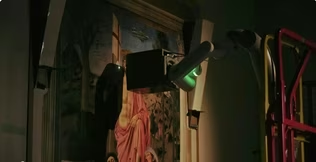
3D scanning of classic works of art raises ethical questions
Video has Closed Captions
Clip: 1/15/2026 | 6m 46s | 3D tech preserves and reproduces masterpieces, raising ethical questions (6m 46s)

How Trump's attack on wind power is impacting the industry
Video has Closed Captions
Clip: 1/15/2026 | 8m 4s | How Trump's attack on wind power is impacting the energy industry (8m 4s)
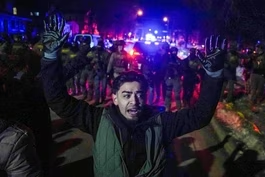
The Insurrection Act's powers as Trump threatens to use it
Video has Closed Captions
Clip: 1/15/2026 | 5m 52s | What is the Insurrection Act? Explaining its powers as Trump threatens to use it (5m 52s)
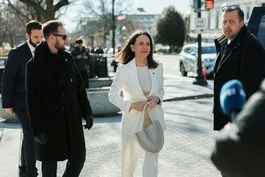
Machado meets Trump amid Venezuelan leadership uncertainty
Video has Closed Captions
Clip: 1/15/2026 | 8m 45s | Machado presents Trump her Nobel Prize as uncertainty surrounds Venezuela’s leadership (8m 45s)
Mental health, addiction funding restored after backlash
Video has Closed Captions
Clip: 1/15/2026 | 6m 9s | White House slashes, then restores, funding to treat mental health and addiction (6m 9s)
Midwife’s death highlights racial gap in maternal mortality
Video has Closed Captions
Clip: 1/15/2026 | 7m 3s | Black midwife’s death highlights racial gap in maternal mortality (7m 3s)

Minnesota protests escalate as Trump intensifies threats
Video has Closed Captions
Clip: 1/15/2026 | 4m 15s | Minnesota leaders call for calm as protests escalate and Trump intensifies threats (4m 15s)
News Wrap: U.S. places new sanctions on Iranian officials
Video has Closed Captions
Clip: 1/15/2026 | 5m 51s | News Wrap: U.S. places new sanctions on several Iranian officials (5m 51s)
Providing Support for PBS.org
Learn Moreabout PBS online sponsorship
- News and Public Affairs

FRONTLINE is investigative journalism that questions, explains and changes our world.

- News and Public Affairs

Today's top journalists discuss Washington's current political events and public affairs.





Support for PBS provided by:
Major corporate funding for the PBS News Hour is provided by BDO, BNSF, Consumer Cellular, American Cruise Lines, and Raymond James. Funding for the PBS NewsHour Weekend is provided by...